
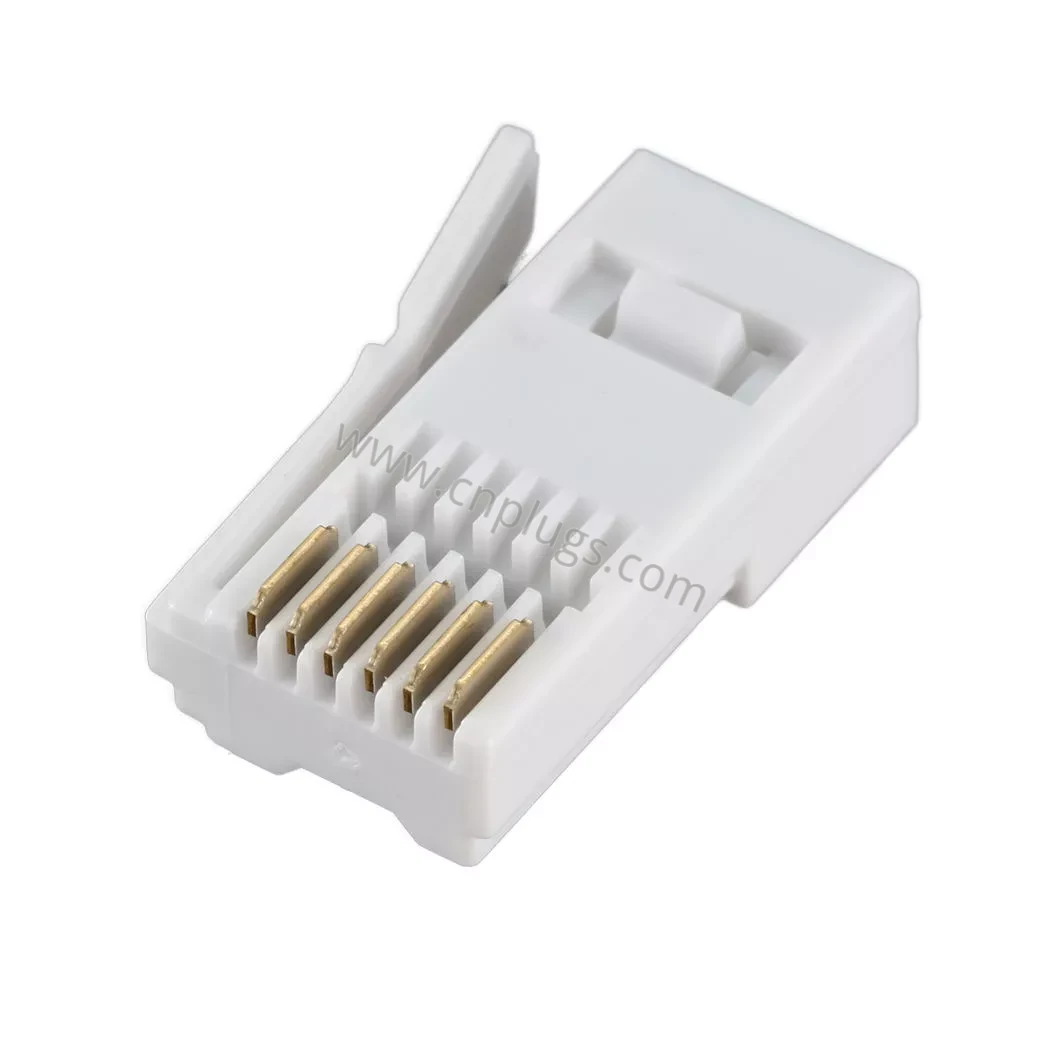
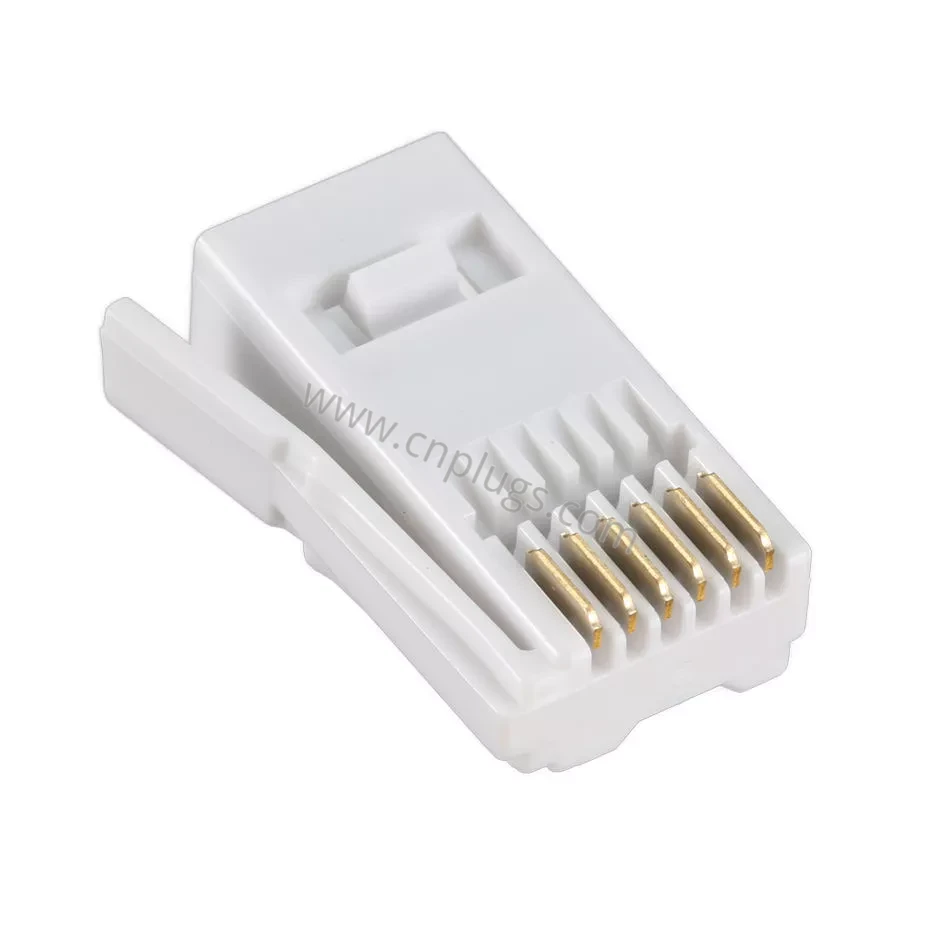
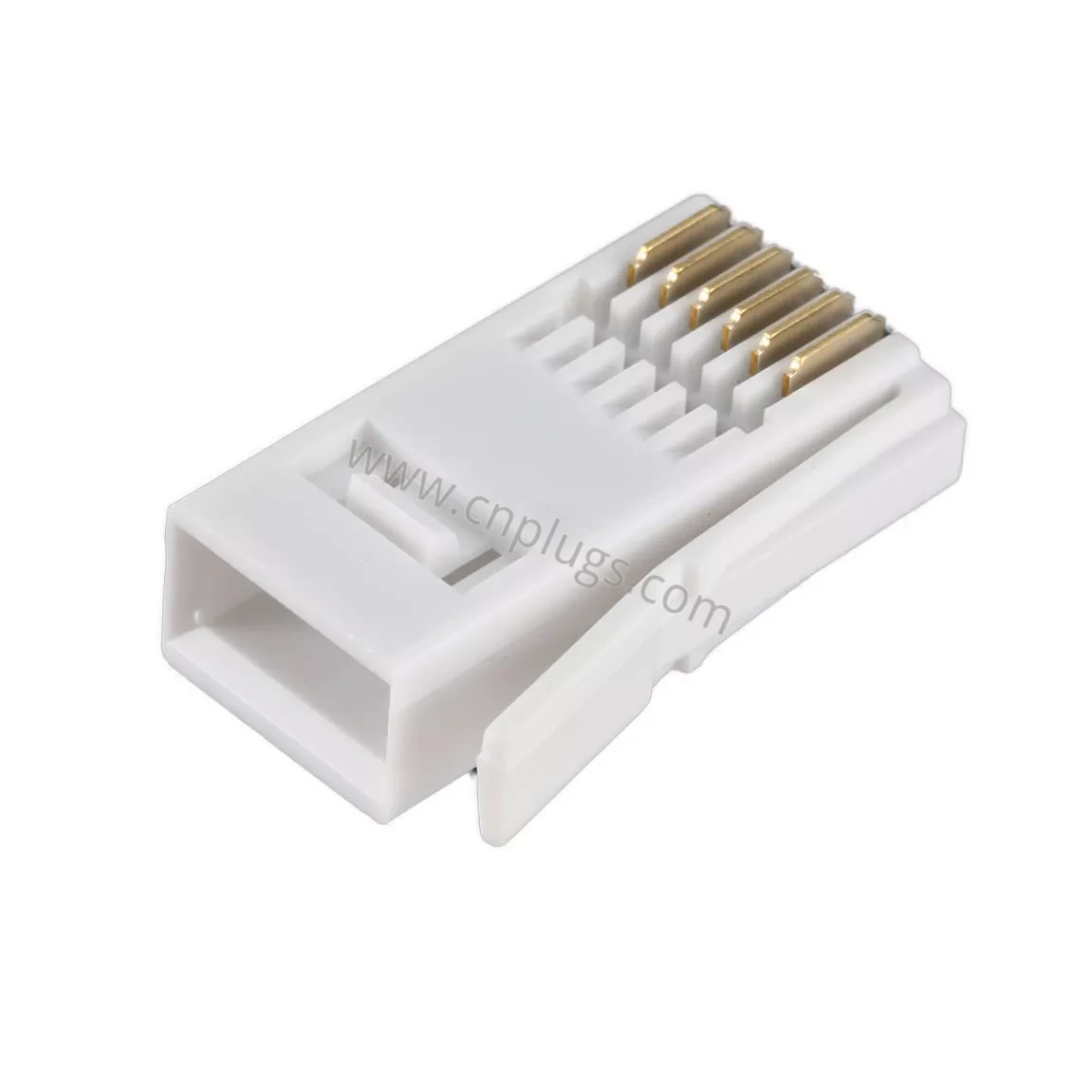
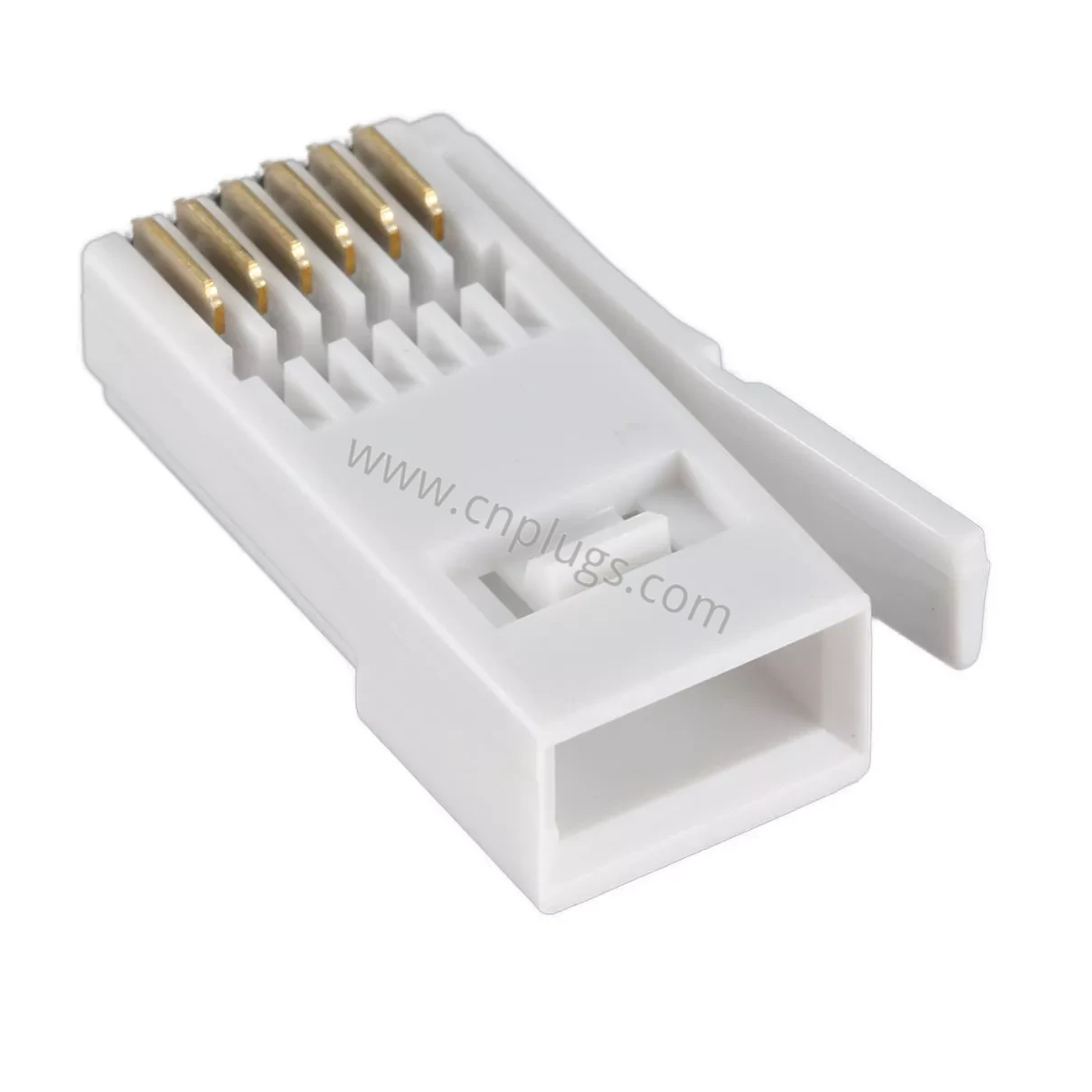
BT 631A UK Telephone Plug: The 6P6C BS 6312 British Standard Connector, Made in Our Own Factory
If you have arrived here holding a plug with the latch on its side, you are holding a British telephone plug and not an RJ11, whatever the listing you bought it from claimed. That distinction is the whole reason this page exists. Prounta manufactures the BT 631A plug — six positions, six gold-plated contacts, moulded to British Standard BS 6312 — for cable assembly houses, telecom wholesalers, alarm and lift installers and distributors serving the UK, Ireland and Commonwealth markets. This page explains exactly what the part is, how it differs from the American connectors it is constantly confused with, and how to specify it correctly the first time.
What a BT Plug Is, and Why It Is Not an RJ11
British telephone sockets were introduced in their present plug-and-socket form on 19 November 1981, when British Telecom moved to the “New Plan” wiring policy so that subscribers could buy and connect their own telephones rather than rent them. The connectors are specified in British Standard BS 6312, and they are described in detail in the Wikipedia article on British telephone sockets. They resemble the American modular connectors used for RJ11 — same general family, same idea of positions and contacts — but with one deliberate, decisive difference.
The retaining latch is mounted on the side of the plug body, not underneath it. That is why a BT plug will not enter an RJ11 socket and an RJ11 plug will not lock into a UK Type 600 socket. The two are physically incompatible by design, not by accident. Every photograph on this page shows that side latch clearly, and it is the fastest way to confirm you are ordering the right part: look at the latch, not at the pin count.
The second difference is electrical, and it catches out far more people than the mechanical one. A UK telephone line runs on pins 2 and 5 of the BT plug. RJ11 puts the line on pins 3 and 4. This is why plugging an American telephone or modem cord into a UK socket through a simple mechanical adapter often produces nothing at all: the adapter solved the shape problem and left the wiring problem untouched. Anyone building leads for the UK market needs to know which convention each end follows before cutting a single conductor.
631A or 431A? Choosing the Right One
There are two BT plugs in common use and the relationship between them is simpler than most sources make it sound. The 431A is a 631A with the two outer contacts left out. Both have six positions in the housing; the 431A populates four of them, the 631A populates all six. They are intermateable and both fit the standard Type 600 socket.
Choose the 431A for a conventional single analogue line where only Line A, Line B and the bell and earth circuits are needed. Choose the 631A — the part on this page — when all six ways are required: system telephones and legacy PBX handsets, multi-line equipment, installations that carry the bell circuit and the earth-recall wire, and any assembly where you would rather populate every position than stock two part numbers. Because the 631A mates with 431A sockets, many assembly houses standardise on it and simply leave the unused conductors unterminated. If your annual volume is split across both, ask us to quote them together; they share tooling and the combined price is usually better than two separate orders.
Pin Numbering: The Detail That Causes Most Wiring Errors
This deserves its own section because the published information is genuinely contradictory. When BS 6312 was drawn up, the pin numbering was reversed between the plug and the socket, so that pin 6 on the plug connects to pin 1 in the socket, pin 5 to pin 2, and so on. A great many wiring diagrams online were produced by someone reading socket numbering and applying it to plug pins, which is why two apparently authoritative sources will confidently disagree.
The working convention used across the UK trade is this: hold the plug with the contacts facing you and the side latch to the right, and number the pins from the outside inwards, starting at pin 1 nearest the release lever. On a 431A, contacts 1 and 6 are absent, so counting starts at pin 2 — which is precisely why UK line documentation refers to pins 2 and 5 rather than 1 and 4. The functional assignment across the six ways is: pin 1 reserved, pin 2 Line B, pin 3 bell, pin 4 earth, pin 5 Line A, pin 6 reserved. In modern installations the bell and earth conductors are frequently unused, since the ring capacitor now lives in the master socket, but they remain wired in a great deal of existing infrastructure and in system-phone cabling — which is exactly the case for a six-way plug.
One further trap worth stating plainly: a flat telephone cord terminated with the pins on the same side at both ends produces a reversed connection, because the two plugs face opposite directions. If you are building a straight-through lead, the cable must be presented consistently, and if you are building a crossover lead, it must not. Verify the first article with a continuity tester before releasing a production run. This is the single most common defect we see returned in telephone lead manufacturing, and it costs nothing to catch at unit one.
Contacts, Materials and Build
The contacts are phosphor bronze — a copper alloy chosen because it holds spring temper and has the hardness to displace conductor insulation cleanly. We describe the metallurgy accurately rather than advertising “pure copper” contacts as some sellers do; pure copper is too soft for an insulation-displacement blade and would relax under load. The plating is selective gold over a nickel barrier layer, which matters more on a telephone circuit than many buyers expect: analogue voice runs at low voltage and low current, so contact resistance rising through oxidation is the dominant long-term failure mode, producing crackle, hum and intermittent dropouts long before anything fails outright. Gold over nickel keeps the interface stable for the life of the installation.
The housing is moulded from virgin polycarbonate to UL 94V-0, with high clarity so the conductor colour order can be inspected through the body both before and after crimping — a small feature that pays for itself in any production environment with a visual QC step. Mouldings are burr-free and dimensionally consistent for reliable feeding in semi-automatic crimp lines. The strain-relief bar grips the cable jacket rather than the conductors, so repeated plugging and unplugging does not work the terminations loose. As a member of the wider modular connector family, the part follows the same six-position geometry as other 6P connectors while retaining the BS 6312 body and latch profile.
Technical Specifications
| Parameter | Specification |
|---|---|
| Model No. | PR-BT631A-6P6C |
| Connector Type | BT 631A UK telephone plug, 6 position 6 contact (6P6C) |
| Standard | BS 6312 (British Standard telephone connector) |
| Latch Position | Side-mounted (BS 6312 profile — not RJ11 compatible) |
| Mating Socket | UK Type 600 socket, LJU master and extension sockets; mates with 431A sockets |
| Contacts Populated | 6 of 6 positions |
| Pin Assignment | 1 reserved · 2 Line B · 3 bell · 4 earth · 5 Line A · 6 reserved |
| Contact Material | Phosphor bronze (copper alloy) |
| Contact Plating | Selective gold over nickel (thickness options on request) |
| Termination | Insulation displacement, crimp |
| Housing Material | Virgin polycarbonate, high clarity, UL 94V-0 |
| Cable Type | Flat 6-way modular telephone cord, stranded |
| Conductor Size | 26–28 AWG stranded |
| Current Rating | 1.5 A per contact |
| Voltage Rating | 150 V AC (rms) |
| Contact Resistance | ≤ 20 mΩ |
| Insulation Resistance | ≥ 500 MΩ @ 500 V DC |
| Dielectric Strength | 1000 V AC / 1 minute, no breakdown |
| Durability | ≥ 750 mating cycles |
| Operating Temperature | -40 °C to +85 °C |
| Colour | White standard; clear, black and custom colours available |
| Required Tool | Standard BT/6P modular crimp tool |
| Compliance | RoHS, REACH, ISO 9001, UL-recognised materials |
| Packaging | 100 pcs/bag, 50/100 pcs jar, blister card, OEM carton |
| MOQ / Lead Time | Stock from 1,000 pcs; custom logo from 10,000 pcs; 7–15 days |
Who Buys This Part, and Why We Still Make It
Analogue telephony in the UK is a mature market, and that is precisely why it is a good one to supply properly. The installed base is vast: millions of master and extension sockets, alarm panels and auto-diallers, lift emergency telephones, card payment terminals, fax machines, door entry systems and legacy PBX handsets, all of which continue to need leads, repairs and spares. Meanwhile the number of manufacturers still tooled for BS 6312 parts keeps falling as attention moves elsewhere. Steady replacement demand and a thinning supplier base is a favourable combination for a factory whose tooling is already amortised and whose minimum order quantities are low.
Our customers for this part are cable assembly houses building UK telephone leads, telecom and electrical wholesalers stocking for the trade, alarm and lift maintenance companies, and distributors serving the UK, Ireland, and Commonwealth markets that adopted BS 6312 conventions. If you are assembling leads, tell us the cable you use and we will confirm fitment against its actual dimensions before you order. Browse the full telecom connector range for adjacent part numbers, including handset and multi-way variants.
Custom Logo, Private Label and Factory-Direct Supply
Prounta manufactures in our own facility under ISO 9001 process control with full lot traceability to mould cavity and plating batch. Because there is no trading company between you and the plant, the specification you are quoted is the specification that ships, and a question about plating thickness or resin grade gets an answer the same day. We supply 2D drawings, datasheets and RoHS and REACH declarations with quotation.
Custom logo marking is available from 10,000 pieces, along with private-label packaging, your own part numbering and barcodes, custom housing colours and blind shipment to your customers. For buyers who also supply data cabling, our full connector range lets you consolidate telecom and network parts onto a single order and a single shipment. Free samples are available to qualified buyers — send us your requirement with your target volume and cable specification and we will quote and ship samples against it.
Frequently Asked Questions
Is a BT plug the same as an RJ11?
No. They belong to the same broad modular connector family but are not interchangeable. The BT plug specified in BS 6312 has a side-mounted latch, while RJ11 has a bottom-mounted latch, so neither will seat and lock in the other’s socket. The wiring differs too: UK lines use pins 2 and 5, RJ11 uses pins 3 and 4. Sellers who list BT plugs as “RJ11” are being loose with terminology and it causes real ordering mistakes.
What is the difference between a 431A and a 631A?
Only the number of contacts fitted. Both use the same six-position body; the 431A populates four positions and the 631A populates all six. They are intermateable and both fit a Type 600 socket. Use the 431A for a standard single line, and the 631A — this product — for system phones, multi-line equipment, bell and earth wiring, or simply to keep one part number covering every job.
Which pins carry the phone line in the UK?
Pins 2 and 5: pin 2 is Line B and pin 5 is Line A. Pin 3 carries the bell circuit and pin 4 the earth, both of which are unused in many modern installations because the ring capacitor now sits in the master socket. Pins 1 and 6 are reserved and are the two positions absent from a 431A.
Why does my American phone cable not work in a UK socket?
Two separate reasons, and an adapter usually solves only one. Mechanically, the latch positions differ, so the plug will not fit without an adapter. Electrically, the line sits on different pins at each end — 2 and 5 in the UK, 3 and 4 on RJ11 — so a straight-through cable through a mechanical adapter may leave the line unconnected. You need either a correctly wired crossover lead or an adapter that remaps the pins, depending on what the telephone base expects.
Can I use this plug on round telephone cable?
It is designed for standard flat modular telephone cord with the conductors laid side by side, which is what virtually all UK telephone leads use. Round cable does not present the conductors in the flat plane the contacts expect and will give unreliable terminations. If you have a round-cable application, contact us and we will advise on the right approach.
Do I need a special crimp tool?
A standard 6-position modular crimp tool that accepts BT plugs will do the job. Because the latch is on the side, some cheaper RJ11-only tools do not seat BT plugs correctly in the die — check the tool is rated for BS 6312 plugs before running a production batch, or you will crimp inconsistently and not know why.
Will these still be needed with the UK PSTN switch-off?
Yes, for a long time. New voice services are moving to IP, but the physical installed base of sockets, extension wiring and connected equipment does not disappear when the exchange technology changes — alarm panels, lift telephones, payment terminals and countless handsets remain in service and still need leads and repairs. We continue to hold tooling and stock for this part precisely because replacement demand is steady while the number of suppliers is shrinking.
What are your minimum order quantity and lead time?
Stock parts ship from 1,000 pieces, custom logo shells from 10,000 pieces, and standard lead time is 7 to 15 days depending on plating specification and packaging. Free samples go to qualified buyers. Send us your target volume and the cable you intend to use, and we will confirm fitment in writing before you commit.
 WeChat ID: