
A purchase order is a weak place to discover that your supplier cannot answer engineering questions. Everything below should be asked in writing, before the first PO, and the answers should be kept. Written answers do two jobs: they filter suppliers fast, and they become the baseline you hold the factory to when lot three does not look like the samples.
This is the second article in our sourcing series. The first one covers how to find and verify an RJ45 connector manufacturer in China, including how to separate factories from trading companies. This one assumes you have a shortlist and gives you the question set. We publish it from a factory’s side of the table, at PROUNTA in Dongguan. Every question here is one we answer about ourselves, and the links to our own pages let you check the answers live.
Capability: Can They Actually Make Your Part?
1. Do you stamp the contacts and mold the housings in house?
Contact blade geometry and housing tolerances are the two things that decide whether a plug works, and both are process-dependent. A supplier who outsources both is a logistics company, not a manufacturer, and deviations take weeks to close. In-house is the strong answer; a named subcontractor with incoming inspection data is acceptable.
2. Who develops and owns the molds for custom parts?
If you plan OEM work, ask who owns the tooling and where it is stored before you pay for it. Factories with an in-house mold workshop will quote mold cost, cycle count and tolerance; see for example our mold and production pillars. Vague ownership means your custom plug can become someone else’s stock item.
3. What is your daily output, and what is the lead time for a 20-foot container of my mix?
Capacity numbers are easy to inflate, so ask for the breakdown: machines running, shifts, current utilization. The useful signal is whether they ask about your SKU mix before answering. Mixed SKUs consume changeover time; a factory that quotes a container lead time without asking the mix has not planned your order.
4. Which export markets and customer types do you serve today?
You want a supplier already fluent in your market’s paperwork. If you sell into the EU, RoHS and REACH documentation must be routine. If you are a brand owner, ask whether they run private-label programs; our OEM/ODM page shows what that looks like from our side: laser logo etching, custom jars and poly bags, barcoded retail packaging.
5. Can we do a live video walk through stamping, molding and QC this week?
A scheduled call with a shot list, not a promo video. This question alone removes a large share of the field. The full method is in the verification article.
Engineering: Will the Plug Fit and Perform on Your Cable?
6. Here is my cable’s jacket OD, AWG, conductor type and shield. Which plug fits, and what is its fit range?
Category is a performance target, not a fit specification. Two plugs labeled Cat6 can accept different cables. A real factory answers with numbers, for example a conductor range in millimeters and a jacket OD window. If you have not read it, our technical guide’s cable-fit section explains the five values a supplier needs from you.
7. What gold plating thicknesses do you offer, and how is each batch verified?
The honest answer is a menu: flash, 3, 6, 15, 30 and 50 micro-inch over nickel, with X-ray fluorescence measurement per plating batch. “Good plating” is not an answer. Thickness selection by use case is covered in our gold plating guide; our lab measures to 50 µin with an XRF gauge, documented on the testing page.
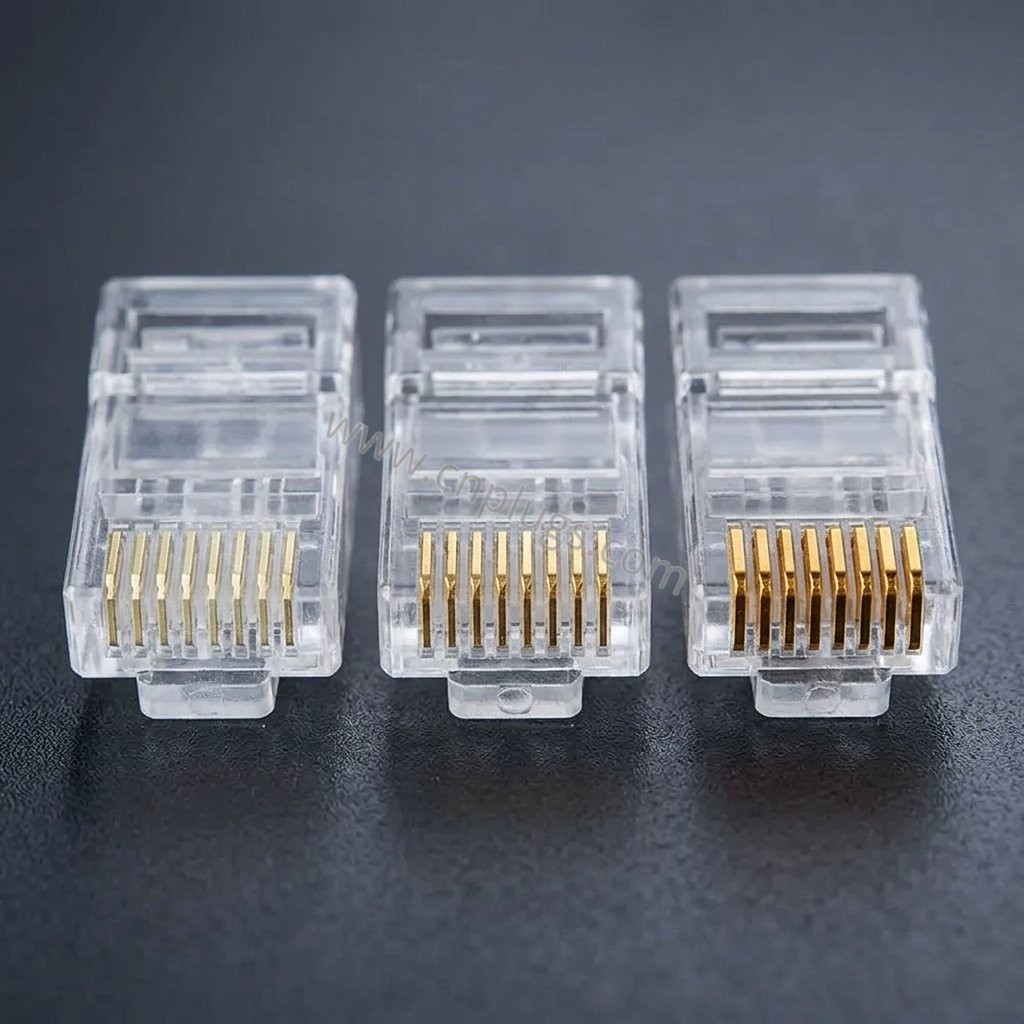
8. What contact alloy and housing material do you use, and what is the flammability rating?
Contacts are typically phosphor bronze or brass; housings are polycarbonate rated UL 94 V-0 or V-2. Ask for the material certificates at incoming inspection, not a datasheet adjective. Material substitution inside the housing is invisible in photos and visible in your failure rate.
9. Can you provide a channel or permanent link test report for the category you claim?
For Cat6A and Cat8 claims this is non-negotiable: NEXT, return loss and insertion loss against ISO/IEC 11801 or ANSI/TIA-568.2-D limits, measured on an analyzer such as a Fluke DSX series, on the exact plug and cable combination. A family certificate is marketing; a report per termination is evidence.
10. Do you test for PoE, including 4PPoE resistance unbalance?
If your customers run IEEE 802.3bt Type 3/4 power, unbalanced contact resistance turns a plug into a heater. Ask whether resistance unbalance is measured, not assumed. This is one of the checks on our test bench.
Quality System: What Happens When Something Goes Wrong?
11. What are your QC stages, and which checks are 100 percent versus sampling?
Listen for structure: incoming material control, in-process checks, final electrical test, outgoing audit. Ask specifically what is inspected on every unit versus what is sampled. Automated optical inspection of every finished plug is the modern baseline for blade position and deformation.
12. How do you classify defects, and what AQL levels will you commit to in writing?
Pre-shipment inspection runs on ISO 2859-1 sampling plans, and the AQL numbers you set for critical, major and minor defects decide whether a marginal lot ships. Common practice in electronics sits around 0 for critical, 0.65 to 1.0 for major and 2.5 for minor. The commitment belongs in the contract, not in a chat message.
13. Show me your deviation process: what happens when a lot fails your own final test?
Every factory has nonconforming material; mature ones can describe quarantine, root cause analysis and customer notification in two minutes. Ask for a real example from the last twelve months. A supplier with no remembered deviations has no memory, which is worse.
14. Do you accept third-party inspection, and can I see your latest audit report?
SGS, Intertek, Bureau Veritas or an agency you choose, at your discretion, before shipment. If a supplier refuses inspection on a first order, there is no second order to lose. Our inspection workflow and documentation are described on the quality and testing page.
15. What documentation ships with each lot?
At minimum: certificate of conformity, RoHS and REACH documents, plating and test reports for the batch, and traceability from lot code back to production date. Ours are downloadable from the certifications page.
Commercial Terms: Is the Deal Actually Workable?
16. What is the MOQ per SKU, and what changes for OEM packaging or logo?
Standard SKUs usually move by bag or carton; customization raises minimums because it consumes setup and tooling. A written MOQ list per product line lets you compare suppliers on the same numbers.
17. What drives your lead time, and what is realistic for reorder versus first order?
First orders carry sampling, packaging artwork and sometimes tooling; reorders should be shorter and predictable. Ask for both numbers and for the bottleneck. If plating is outsourced, plating batches are often the hidden constraint.
18. What packaging and labeling options do you run, and can I see samples of my artwork applied?
Private label lives in the details: bag or jar, barcode standard, carton marking, laser-etched logo position. Request physical or video proof of your artwork on real packaging before the PO, not a mockup.
19. What are your payment terms, and will you release final payment after a passing pre-shipment inspection?
The inspection gate is the single most useful term a new buyer can negotiate. A confident factory accepts it; it costs them nothing when the lot is good.
20. After the PO, who answers my messages: sales only, or an engineer too, and within what time?
Problems are engineering problems. Ask for the escalation path and a response-time commitment in writing. “Within 12 hours” is the kind of number we publish on our contact page; make your supplier put theirs in the contract.
Use It as a Single Email
Send all twenty questions in one message, with your cable specification attached, and score the replies on completeness and speed. A real factory returns most answers the same week, asks clarifying questions about your cable, and pushes back on anything ambiguous. A weak supplier mirrors your wording back at you.
| # | Question | Strong Answer Sounds Like |
|---|---|---|
| 1 | In-house stamping and molding? | Machine list, process flow |
| 2 | Mold ownership for custom parts? | Written tooling agreement |
| 3 | Capacity and container lead time? | Asks your SKU mix first |
| 4 | Export markets and customer types? | Names regions, doc sets |
| 5 | Live video audit this week? | Schedules it with a shot list |
| 6 | Plug fit for my exact cable? | OD and AWG ranges in mm |
| 7 | Plating menu and verification? | 3 to 50 µin, XRF per batch |
| 8 | Alloys, housing, flammability? | Material certs at IQC |
| 9 | Channel test report per claim? | Fluke report, exact combo |
| 10 | PoE 4PPoE unbalance tested? | Measured, per 802.3bt |
| 11 | QC stages, 100% vs sampling? | AOI 100%, defined gates |
| 12 | Written AQL commitment? | Values per defect class |
| 13 | Deviation process, real example? | Story with dates and actions |
| 14 | Third-party inspection accepted? | Yes, your agency, pre-shipment |
| 15 | Docs per lot? | CoC, RoHS/REACH, traceability |
| 16 | MOQ per SKU and OEM? | Written MOQ list |
| 17 | Lead time drivers? | First order vs reorder split |
| 18 | Packaging proof with my artwork? | Physical or video proof |
| 19 | Payment gated on inspection? | Accepted in writing |
| 20 | Engineer access and response time? | Named contact, hours stated |
If you want the deeper background on what each answer means technically, the complete buyer’s guide and the full technical guide cover selection, quality control and supplier evaluation in depth. And if you would rather run the checklist against a factory directly, request samples and quotes from PROUNTA; we answer these twenty in writing, about ourselves.
FAQ
Should all twenty questions go into one email?
Yes. One structured message with your cable specification attached forces organized suppliers to show their organization and disorganized ones to show theirs. Keep the replies in a comparison spreadsheet; that file becomes your audit baseline later.
What AQL levels are reasonable to write into a connector purchase order?
Practice varies by product and risk, but electronics buyers commonly work around 0 for critical defects, 0.65 to 1.0 for major and 2.5 for minor, under ISO 2859-1 General Inspection Level II. The exact values matter less than the fact that they are written into the contract together with the defect classification.
Is ISO 9001 enough, or do I still need pre-shipment inspection?
ISO 9001 audits a management system, not your lot. Inspection inspects your lot. For a first order the two are complementary: the certificate tells you the factory runs a system, the inspection tells you what is in the cartons.
How fast should a real factory answer an RFQ with these questions?
For standard products, an organized factory replies within one or two working days with a written quotation and answers to most technical questions. Custom parts take longer because engineering has to review fit and tooling; that delay is a good sign if it comes with detailed follow-up questions.
 WeChat ID: