
When sourcing RJ45 connectors, buyers often focus first on cable category: Cat5e, Cat6, Cat6A, or Cat8. That is important, but it is not the complete specification. Another essential decision is whether the connector should be unshielded (UTP) or shielded (STP/FTP compatible).
A shielded RJ45 plug is not automatically a better choice for every project. In many office and general LAN installations, an unshielded plug used with compatible UTP cable is practical, cost-effective, and reliable. In other environments—especially those with electrical noise, shielded cabling systems, or higher-performance requirements—a shielded connector can be the right choice.
This guide explains the difference between UTP and STP RJ45 plugs, when shielding is useful, and what distributors, installers, and OEM buyers should confirm before placing an order.
Quick answer
Choose a UTP RJ45 plug when you are using compatible unshielded twisted-pair cable in typical office, retail, residential, or general network installations with no special shielding requirement.
Choose a shielded RJ45 plug when your cable is shielded and the system design requires a continuous shield path, or when the installation environment has significant electromagnetic interference (EMI) that must be addressed at the cabling-system level.
The most important rule is simple: select the plug as part of a complete compatible cabling channel. Cable, plug, jack, patch panel, grounding method, installation practice, and testing requirements should be considered together.
What is a UTP RJ45 plug?
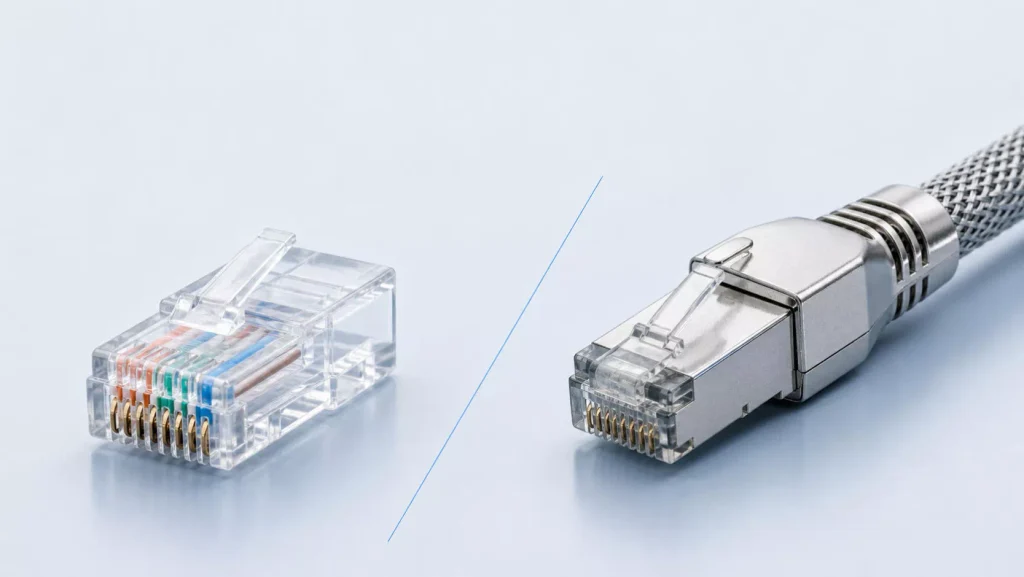
UTP means Unshielded Twisted Pair. A UTP RJ45 plug is normally built with a non-metallic housing, often clear or colored polycarbonate, and is intended for compatible unshielded Ethernet cable.
The twisted pairs inside the cable help reduce interference, but the cable and connector do not include a metal shield around the pairs or a metal connector shell for shield termination.
Typical UTP RJ45 plug applications
- Office LAN cabling
- Home and small-business networks
- Retail networks and POS connections
- Standard IP camera installations
- Wi-Fi access points
- Telecom and general structured cabling
- Standard patch-cord assembly
For many of these applications, a correctly specified UTP cable and UTP plug provide a practical solution. Installation quality, correct termination, and cable testing remain essential.
What is a shielded STP RJ45 plug?
In the market, “STP RJ45 plug” is commonly used to describe a shielded modular plug with a conductive metal shell or shield structure. Depending on the cable construction, buyers may also encounter terms such as FTP, F/UTP, S/FTP, or other shielded twisted-pair descriptions.
A shielded plug is designed to work with compatible shielded cable and can help maintain a shield path through the connector when the full system is designed and terminated correctly. Many shielded RJ45 plugs use a metal shell around the plug body and may include a cable-clamp or grounding feature.
Typical shielded RJ45 plug applications
- Industrial automation and control cabinets
- Factory and machinery environments
- Data rooms and high-density network installations
- Sites with motors, drives, inverters, or switching equipment
- Shielded Cat6A and Cat8 cabling systems
- Installations where the project specification requires shielded components
UTP vs. STP RJ45 plugs: key differences
| Feature | UTP RJ45 Plug | Shielded STP RJ45 Plug |
|---|---|---|
| Housing construction | Usually polycarbonate or other non-metallic housing | Often includes a conductive metal shell or shield structure |
| Intended cable | Compatible unshielded twisted-pair cable | Compatible shielded cable |
| Shield continuity | No connector shield path | Can support a shield path when the full system is correctly designed |
| Typical environment | Standard office, retail, residential, general LAN | EMI-sensitive, industrial, shielded structured-cabling, high-performance applications |
| Installation complexity | Usually simpler | Requires attention to shield termination and grounding design |
| Typical cost | Usually lower | Often higher due to metal construction and added design features |
| Main selection factor | Cable size, conductor type, and termination compatibility | Cable size, shielding construction, grounding plan, and complete system compatibility |
When does EMI matter?
EMI, or electromagnetic interference, is unwanted electrical noise that can affect nearby signal cables. Common sources may include motors, variable-frequency drives, inverters, transformers, large power cables, welding equipment, fluorescent or LED lighting systems, and radio-frequency equipment.
Twisted-pair cable inherently uses pair twisting to manage interference. In many typical network environments, this is sufficient when cable routing and installation practices are good.
In electrically demanding environments, however, a shielded cabling system may be specified to help manage interference. Shielded RJ45 connectors can be part of that system, but they are not a stand-alone cure for every network issue. Poor grounding, improper shield termination, incorrect cable routing, or unsuitable equipment can still cause problems.
Important: shielding is a system decision
A common mistake is to add a metal RJ45 plug to an otherwise unshielded or poorly planned cabling run and expect it to solve EMI issues. That approach may not deliver the intended result.
For a shielded channel, review the following components together:
- Cable construction — Is the cable actually shielded, and what type of shield does it use?
- RJ45 plug — Does the connector fit the cable and provide the required shield termination method?
- Keystone jack or outlet — Is it compatible with the shielded channel design?
- Patch panel and equipment interface — Does the installation maintain the intended shield continuity?
- Grounding and bonding — Is the approach aligned with the project design and relevant local standards?
- Cable routing — Are network cables separated from sources of high electrical noise where practical?
- Testing — Has the completed link been tested according to the project requirement?
If any of these elements is incompatible, the benefit of a shielded plug can be limited.
When a UTP RJ45 plug is the better option
A UTP connector is often the right choice when the cable itself is unshielded and the installation is a conventional commercial or residential LAN environment.
1. General office and commercial networks
In a typical office, retail store, classroom, or small-business installation, compatible UTP Cat5e or Cat6 cabling is widely used. A properly terminated UTP connector is often sufficient for computers, phones, printers, access points, and general network devices.
2. Standard field termination
UTP plugs are generally straightforward to assemble. Installers can choose standard closed-end plugs or pass-through designs depending on their preferred workflow and tool availability.
For compatible 23–24 AWG Cat6 UTP solid or stranded cable, PROUNTA’s EZ Pass-Through Cat6 RJ45 Unshielded Modular Plug provides a clear-housing, pass-through option for checking conductor order before crimping.
3. Cost-conscious wholesale programs
For distributors supplying standard network-installation products, UTP plugs can offer an efficient product line with broad demand. The priority should still be stable molding quality, suitable contacts, accurate cable compatibility, consistent packaging, and dependable quality control.
When a shielded RJ45 plug is the better option
1. Industrial and automation environments
Factories and control environments may include motors, drives, inverters, and power equipment. Where a shielded Ethernet system is specified for the installation, a shielded connector may be required to support the intended channel design.
PROUNTA’s Industrial & Inverter Plugs are intended for applications where connector construction and EMI considerations are particularly relevant.
2. Shielded Cat6A or Cat8 systems
Cat6A and Cat8 installations often have more demanding physical and performance requirements. When the selected cable is shielded, choose a connector designed for that category, conductor size, outside diameter, and shield structure.
Explore Cat6A & Cat8 Shielded Plugs for shielded product options.
3. High-noise cable routes
If a network cable must run near potential sources of electrical noise, first consider route planning and separation practices. Where the project engineer specifies a shielded channel, the plug should be selected to match the shielded cable and the rest of the system.
4. Projects with a defined shielded-cabling specification
Some projects specify shielded components for consistency, compliance, or site conditions. In this case, follow the project specification and verify every component in the channel rather than substituting individual parts based only on appearance.
How to select a shielded RJ45 plug correctly
A shielded connector needs more information than “Cat6A metal plug.” Include the following points in your purchasing specification.
Cable category and cable dimensions
Confirm the cable category, bare conductor gauge, insulated conductor diameter, overall cable outside diameter, and whether the conductors are solid or stranded. Larger Cat6A and Cat8 cables may require a specialized plug body or load-bar arrangement.
Cable shield construction
Ask whether the cable is F/UTP, S/FTP, or another shielded construction. The plug’s metal shell and cable-clamp arrangement should be appropriate for the cable and the intended termination method.
Contact design and plating requirement
Confirm the contact style and the stated compatible conductor range. If your application requires a defined plating thickness, insertion-cycle target, or test record, list it clearly in the RFQ.
Tool or tool-free assembly method
Some shielded connectors use a conventional crimping process, while others are designed for field termination or tool-free assembly. Make sure the installation team has the correct process and tools before ordering in quantity.
Grounding approach
The correct grounding and bonding approach depends on the installation design, applicable standards, and local requirements. When in doubt, consult the project engineer or qualified installer rather than treating connector shielding as an isolated product decision.
Does a metal shell always mean better quality?
No. A metal shell may be appropriate for a shielded design, but it does not automatically prove overall connector quality or performance.
For both UTP and shielded RJ45 plugs, evaluate:
- Material consistency and dimensional control
- Cable and conductor compatibility
- Contact design and stated plating specification
- Latch strength and strain relief
- Assembly consistency
- Tool compatibility
- Quality-control documentation
- Sample test results using your actual cable
The right connector is the one that matches the application and is manufactured consistently—not simply the one that contains more metal.
Sample-testing checklist for UTP and shielded plugs
Before a wholesale, OEM, or project order, test the proposed connector with the actual cable and intended tool.
- Confirm conductor fit. All eight conductors should enter the designated channels without excessive force or looseness.
- Check the cable jacket. The strain-relief section should grip the jacket rather than only the individual conductors.
- Inspect contact engagement. The contacts should seat consistently after crimping or field termination.
- Verify wire order. Use the project’s intended T568A or T568B sequence.
- For shielded plugs, inspect shield termination. Follow the connector instructions and project design.
- Perform cable testing. Start with wire-map and continuity checks; use appropriate performance testing when required.
- Record the sample result. For repeat orders, retain the approved cable and connector samples as a reference standard.
Frequently asked questions
Can I use a shielded RJ45 plug with UTP cable?
It may be physically possible with some combinations, but it is generally not a reason by itself to select a shielded connector. The plug should match the actual cable and system design. Using a shielded plug does not turn an unshielded cable into a shielded channel.
Do shielded RJ45 plugs improve internet speed?
A shielded plug does not automatically increase internet speed. It is selected to support a compatible shielded cabling system or address specified environmental and interference requirements. Link performance depends on the complete channel, installation quality, and network equipment.
Are UTP RJ45 plugs suitable for PoE?
Suitability depends on the complete cable and connector specification, conductor size, contact design, project requirements, and applicable standards. Do not make a selection based only on “UTP” or “STP”; verify the complete product specification.
Is a shielded connector necessary for Cat6A?
Not in every case. The correct choice depends on the cable construction and project design. Many Cat6A systems use shielded components, but buyers should follow the cable and system specification rather than assume a universal rule.
What should I send to an RJ45 plug manufacturer for a compatibility check?
Send the cable category, AWG, solid or stranded construction, insulated conductor diameter, cable outside diameter, UTP or shielded construction, application, desired plug style, packaging needs, and target order quantity. A cable datasheet and physical sample are especially helpful.
Final recommendation
UTP RJ45 plugs are a practical choice for compatible unshielded Ethernet cable in standard network installations. Shielded RJ45 plugs are valuable when used as part of a correctly designed shielded cabling system, particularly in EMI-sensitive, industrial, or specified high-performance applications.
Choose based on the complete channel, not on the assumption that a metal connector is always better. Verify cable dimensions, conductor construction, shielding method, tool compatibility, and finished-cable test results before purchasing in bulk.
Need assistance matching a UTP or shielded RJ45 plug to your cable and application? Contact PROUNTA with your cable specification to request product guidance, samples, or OEM packaging information.
 WeChat ID: