
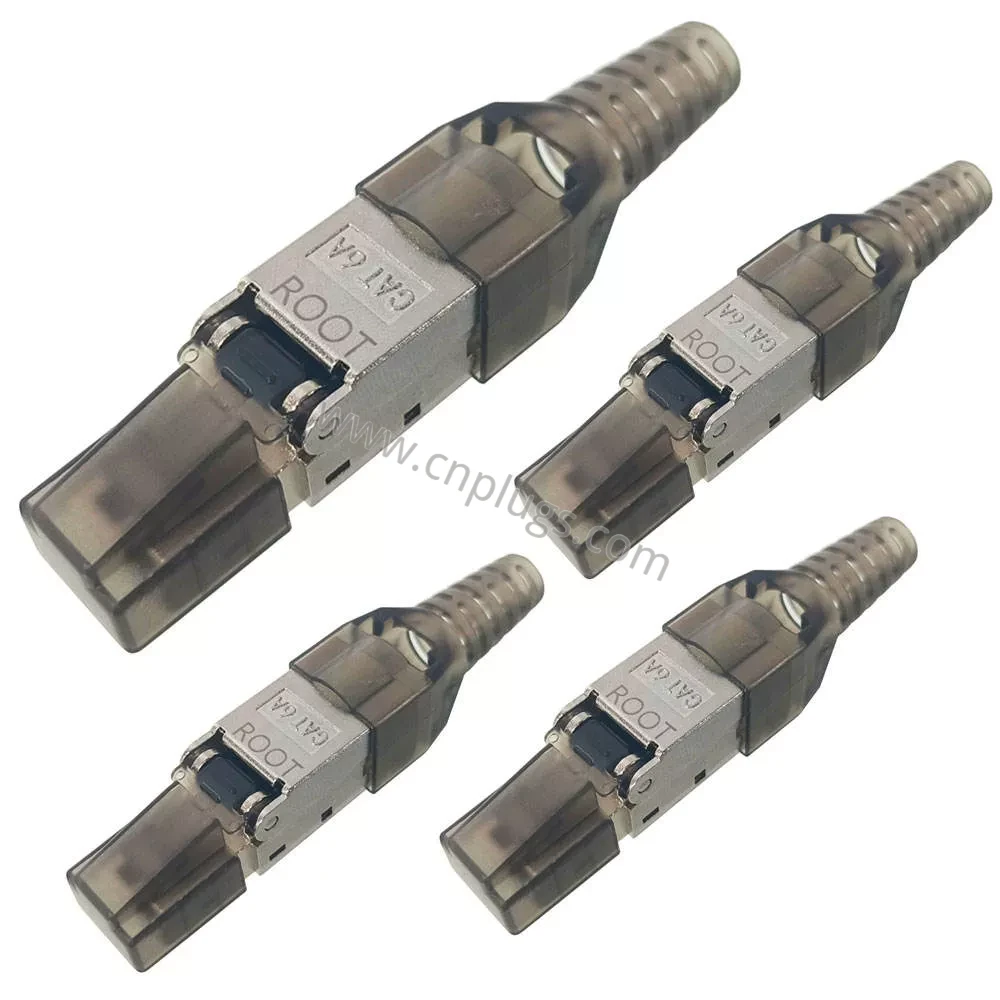
Cat6A Shielded Toolless RJ45 Connector with Clear Housing: Terminate 10G Links Without a Crimp Tool
Every installer who has tried a toolless RJ45 connector has the same question, and it is a fair one: can a plug that assembles by hand really pass a Cat6A certification? The honest answer is that it depends entirely on whether the conductors are seated correctly — and that the reason cheap toolless plugs earned a poor reputation is that they give you no way to check. This connector was designed around that specific problem. The housing is translucent, so the conductor sequence is visible through the body before you close the shell and after you have finished. You are no longer trusting the connector. You are looking at it.
Prounta manufactures this Cat6A shielded toolless connector for installers, integrators, cable assembly houses and distributors who need dependable field terminations without carrying a crimp tool. It terminates 22–26 AWG solid and stranded cable, shielded or unshielded, and delivers full Cat6A performance to 500 MHz and 10 Gigabit Ethernet across a 100 metre channel.
How a Toolless Connector Actually Terminates
There is no crimp die and no punch-down tool involved. The connector arrives in three parts: the front housing carrying the eight contacts, a wire manager that sets the conductor sequence, and the rear body with its integrated strain-relief boot. You slide the boot onto the cable, strip the jacket, fan the pairs into the wire manager in T568A or T568B order, trim the conductors flush, seat the manager into the housing and close the shell. As it closes, insulation-displacement contacts cut through each conductor’s insulation and clamp onto the copper, forming eight gas-tight connections simultaneously.
Gas-tight is the important phrase. The blade slices the insulation and grips the conductor tightly enough to exclude air from the contact interface, which is what prevents oxidation and keeps contact resistance stable for years. It is the same termination principle already trusted throughout the permanent cabling in your building, applied to a male plug rather than to a wall outlet.
Why the Clear Housing Changes the Outcome
Toolless connectors fail for one dominant reason: a conductor that is not fully seated in its channel when the shell closes. The blade catches the edge of the copper instead of biting into it, or misses entirely. The link may still pass a basic continuity check and then fail a certification test, or work at gigabit and collapse at 10G, or fail intermittently months later. Diagnosing it means cutting the connector off and starting again.
An opaque metal housing hides all of this. Once the shell is closed, the termination is a black box. The translucent housing on this connector means the conductor colour sequence stays visible through the body — you confirm the order is correct before you close it, and you can confirm it again afterwards during troubleshooting without destroying the termination. In a building with hundreds of drops, being able to look at a suspect connector rather than replace it is a meaningful saving in labour.
The same clarity helps in production. Cable assembly houses running a visual QC step can inspect the conductor order on every finished assembly without extra tooling, which is precisely why our customers building patch cords in volume ask for translucent housings.
Step by Step: Terminating One Connector
The whole sequence takes under two minutes once you have done a few, and it is worth setting out precisely because most first-attempt failures come from two specific steps.
1. Slide the boot on first. Obvious, and forgotten constantly. Push the trimmable boot onto the cable, wide end towards the connector, before you strip anything.
2. Strip the jacket back about 30 mm. Score and remove the jacket without nicking the foil or the conductor insulation. On F/UTP cable, fold the foil and the drain wire back over the jacket rather than cutting them off — that folded-back foil is what the shield band clamps onto, and cutting it away is the most common reason a shielded termination shows no shield continuity on a test.
3. Untwist as little as possible. Separate the pairs only as far as you must to reach the wire manager. Cat6A tolerates far less untwisting than Cat5e — keep it under about 6.5 mm of untwisted length per pair. Excess untwist degrades near-end crosstalk and is the most frequent cause of a link that passes at 1 Gigabit and fails at 10.
4. Lay the conductors into the colour-coded manager in T568A or T568B order, pushing each one fully to the front stop.
5. Trim flush across the front face of the manager with flush cutters.
6. Check the colours through the housing, then seat the manager and close the shell until it latches. Slide the boot forward. Test.
Step three and step six are the two that separate a certified link from a callback, and step six is the one only a translucent connector lets you perform at all.
Shielding and Cable Compatibility
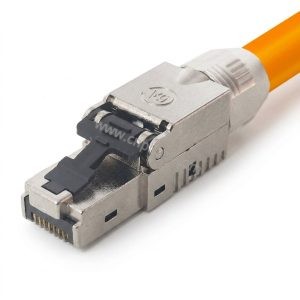
The termination area is enclosed by a nickel-plated metal shield band that bonds to the cable’s foil or braid and carries shield continuity straight through the connector to the mating port. This matters more at Cat6A than at any lower category, because 10GBASE-T is uniquely vulnerable to alien crosstalk — interference coupling between adjacent cables rather than between pairs inside one cable. A continuous shield path is one of the main defences, and it only works if it is unbroken end to end. The principle is set out in the Wikipedia article on electromagnetic shielding: an enclosure only excludes interference if it is electrically continuous.
There is a rule that follows from this and it is worth stating plainly, because getting it wrong is common. Match the connector to the cable. A shielded connector on unshielded cable achieves nothing — there is no shield to bond to. An unshielded connector on shielded cable is worse: it leaves the foil terminated nowhere, and an ungrounded conductor running the length of a building behaves as an antenna rather than a screen. This connector is intended for F/UTP, U/FTP, S/FTP and STP cable. It will physically terminate unshielded cable and works perfectly well doing so, but if your cable is unshielded there is no benefit in paying for the shield.
Fitment: The Numbers That Prevent Returns
Most termination problems that get blamed on connector quality are fitment problems. Cat6A cable is physically larger than Cat6 or Cat5e — thicker insulation to hold pair geometry, often a separator spline, sometimes a heavy jacket for riser or plenum use — and a connector dimensioned for Cat5e simply will not accept it.
This connector accepts 22 to 26 AWG solid or stranded conductors with an insulated conductor OD of 0.90 to 1.10 mm, and a cable jacket OD of 5.0 to 8.0 mm. That covers essentially the whole Cat6A range including oversized shielded riser cable. The ribbed strain-relief boot is moulded so that rings can be trimmed off to match your actual jacket diameter, giving a clean, tight finish on thin and thick cable from the same part number rather than forcing you to stock several.
If you are ordering in volume, send us your cable’s datasheet — specifically the insulated conductor OD and jacket OD — and we will confirm fitment in writing before you commit. It takes us ten minutes and removes the single largest cause of dissatisfaction in this product category.
Technical Specifications
| Parameter | Specification |
|---|---|
| Model No. | PR-C6ATL-T1 |
| Connector Type | Cat6A shielded toolless RJ45 8P8C modular plug |
| Termination Method | Toolless, insulation displacement — no crimp or punch-down tool |
| Category / Bandwidth | Cat6A, 500 MHz |
| Data Rate | 10GBASE-T to 100 m; backward compatible Cat6 / Cat5e |
| Standards | ANSI/TIA-568.2-D, ISO/IEC 11801 Class EA, IEC 60603-7-51 |
| Wiring Scheme | T568A / T568B, colour-coded wire manager |
| Housing | Translucent polycarbonate, UL 94V-0, with nickel-plated metal shield band |
| Shielding | 360° shield continuity, bonds to cable foil or braid |
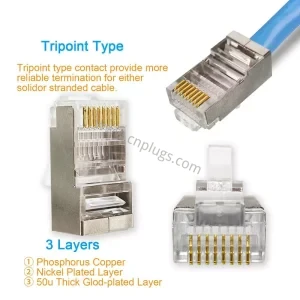
| Contact Material | Phosphor bronze |
| Contact Plating | 50 µ” gold over 100 µ” nickel |
| Conductor Size | 22–26 AWG, solid and stranded |
| Insulated Conductor OD | 0.90 – 1.10 mm |
| Cable Jacket OD | 5.0 – 8.0 mm (trimmable boot) |
| PoE Support | IEEE 802.3af / at / bt, 4PPoE up to 90 W |
| Current Rating | 1.5 A per contact |
| Contact Resistance | ≤ 20 mΩ |
| Shell-to-Shell Resistance | ≤ 50 mΩ |
| Insulation Resistance | ≥ 500 MΩ |
| Dielectric Strength | 1000 V AC / 1 minute |
| Mating Durability | ≥ 750 cycles |
| IDC Re-Termination | Up to 20 cycles |
| Operating Temperature | -40 °C to +85 °C |
| Compliance | RoHS, REACH, ISO 9001 |
| Packaging | 10 / 50 pcs jar, bulk bag, OEM carton |
| MOQ / Lead Time | 500 pcs; custom marking from 10,000 pcs; 7–15 days |
Where This Connector Earns Its Cost
A toolless connector costs more than a crimp plug, so it should be specified where the labour saving or the access constraint justifies it. In practice that means a few clear situations.
Repair and retrofit. A damaged plug on an installed cable can be replaced in place without pulling new cable and without a crimp tool on a ladder. This is where the reusability and the clear housing pay for themselves fastest.
Awkward and high-access locations. Ceiling voids, camera poles, lift shafts, industrial cabinets — anywhere carrying and operating a crimp tool one-handed is difficult. Assembly needs only your hands and flush cutters.
Oversized cable that defeats standard plugs. Heavy shielded riser and outdoor cable often will not fit a conventional plug at all. The wide fitment window and trimmable boot solve that directly.
Low-volume or mixed on-site work. Maintenance crews and integrators terminating a handful of drops across many sites benefit far more from carrying no tool than from a lower per-piece price.
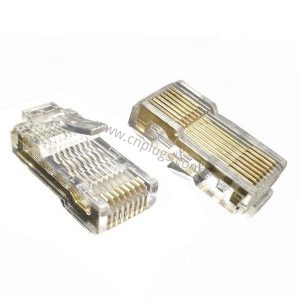
For high-volume patch cord production in a controlled environment, a crimp plug remains more economical per unit — our Cat6A single row shielded modular plug is the right choice there, and our Cat6A and Cat8 plug range covers the full crimp lineup. We would rather tell you that than sell you the wrong part.
Frequently Asked Questions
Are toolless RJ45 connectors reliable enough for a certified installation?
Yes, when the conductors are seated correctly — which is exactly the variable this design controls. The insulation-displacement principle behind it is the same well-proven method used throughout the permanent cabling already installed in your building. What has historically gone wrong with toolless plugs is seating errors hidden inside an opaque housing. Being able to see the conductor sequence through the body before closing the shell removes most of that risk. Certify the link as you would any other and you will have documented proof rather than an assumption.
Do I need any tool at all?
No crimp tool and no punch-down tool. You need a jacket stripper and a flush cutter to trim the conductors, both of which are already in any installer’s pouch. That is the whole tool list.
Can I reuse the connector if I make a mistake?
Yes. The shell opens, the conductors can be re-laid and the connector closes again, rated for up to 20 IDC re-termination cycles. Do bear in mind that each cycle needs fresh conductor length, so leave a little service slack when you first strip the cable.
Will it work with unshielded cable?
Mechanically yes, and it terminates U/UTP perfectly well. But the shield only does something when there is a cable shield to bond to, so if your plant is unshielded there is no performance reason to pay for a shielded connector. Conversely, never put an unshielded plug on shielded cable — an unterminated foil is worse than no foil at all.
My Cat6A cable is very thick. Will it fit?
The connector accepts jacket diameters from 5.0 to 8.0 mm and insulated conductor diameters from 0.90 to 1.10 mm, which covers oversized shielded riser cable that standard plugs reject. The boot is trimmable so the fit stays clean at both ends of that range. Send us your cable datasheet and we will confirm before you order.
Does it support PoE?
Fully. It meets IEEE 802.3af, 802.3at and 802.3bt including 4PPoE up to 90 W, with 1.5 A per contact. The gold-over-nickel plating matters here — PoE current makes a stable, low-resistance contact interface more important, not less.
Can we get our own logo or part number on it?
Yes. Custom marking is available from 10,000 pieces, along with private-label packaging, your own barcodes and housing colour options. We manufacture in our own plant, so tooling and marking changes go straight to the production line.
Toolless or crimp — which should I actually buy?
Decide on volume and access, not on price per piece. If you are building patch cords in quantity at a bench, a crimp plug wins on cost and speed and you should use one. If you are terminating a modest number of drops in awkward places, repairing existing runs, or working with cable too large for a standard plug, the toolless connector wins on total labour even though the part costs more. Many of our customers stock both and use each where it belongs. Tell us your job and we will tell you honestly which one it is.
Is a translucent housing as strong as an opaque one?
Yes. The housing is moulded from virgin polycarbonate rated UL 94V-0 — the same resin family as our clear crimp plugs — and the mechanical load in service is carried by the metal shield band and the latch, not by the transparency of the plastic. Clear polycarbonate is the standard material for RJ45 plug bodies; what is unusual here is applying it to a toolless design where the interior is worth seeing.
What are your minimum order quantity and lead time?
MOQ is 500 pieces for stock configuration and 10,000 pieces for custom marking, with standard lead times of 7 to 15 days. Free samples are available to qualified buyers — send us your requirement with your cable specification and target volume and we will quote and ship samples against it.
 WeChat ID: