
Cat5e Shielded 8P8C Modular Plug: The STP/FTP RJ45 Ethernet Connector Specified by Name on Your Bill of Materials
If you searched for an 8P8C modular plug rather than an RJ45 connector, you are almost certainly working from a drawing, a bill of materials or a request for quotation — and you want the part number to mean something precise. This page is written for that reader. Prounta manufactures the shielded Cat5e 8P8C modular plug described here in our own factory, ships it in volumes from a thousand pieces to tens of millions per month, and supplies the drawing, the material declarations and the test data that a purchasing engineer needs before a part number is released into a production system.
8P8C or RJ45? Both Terms Describe This Part, and Here Is Why
The distinction matters enough to state plainly. 8P8C means eight positions, eight contacts: it describes the physical connector — the housing, the latch and the eight metal blades. RJ45 is a Registered Jack designation, a wiring and interface standard, and the original RJ45S was in fact a keyed eight-position part with only two contacts loaded, intended for telephone-era modem service. Modern Ethernet does not use that wiring scheme at all. What it uses is the 8P8C connector wired to the T568A or T568B pin-pair assignments defined in ANSI/TIA-568.
So, strictly speaking, the ubiquitous “RJ45 connector” is an 8P8C modular plug carrying RJ45-style wiring, and the industry has simply merged the two names. We are not going to pretend otherwise or lecture your customers about it. What we do is print both designations on the drawing and the datasheet, so that your BOM line, your engineering documentation, your customs declaration and your assembly technician are all describing the same object without ambiguity. In cross-border procurement that small courtesy prevents real errors — a specification review that rejects a compliant part on a naming technicality costs far more than the parts. The related but genuinely different variants are modular connectors with fewer contacts loaded, such as 8P4C and 6P4C. If you need a partially loaded eight-position part, see our 8P4C unshielded modular plug; every position in the plug on this page is populated.
What “Shielded” Means at the Connector, in Procurement Terms
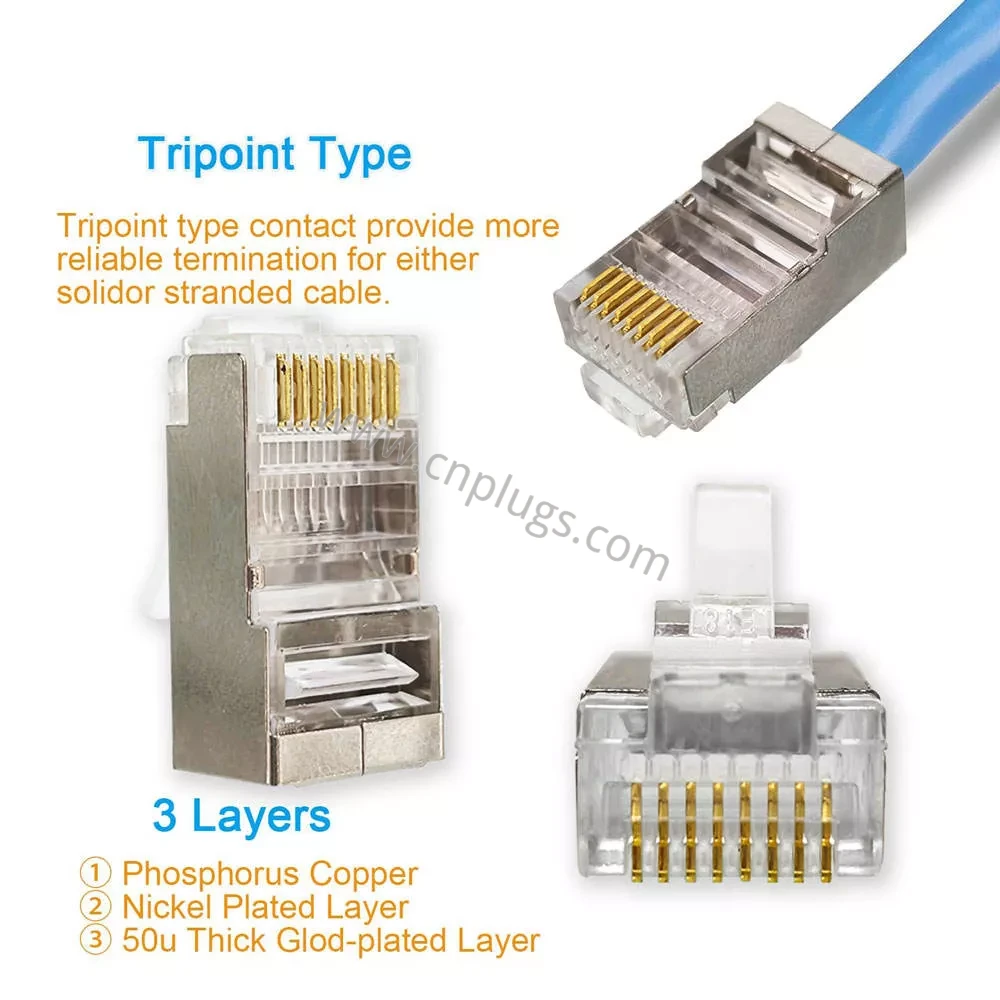
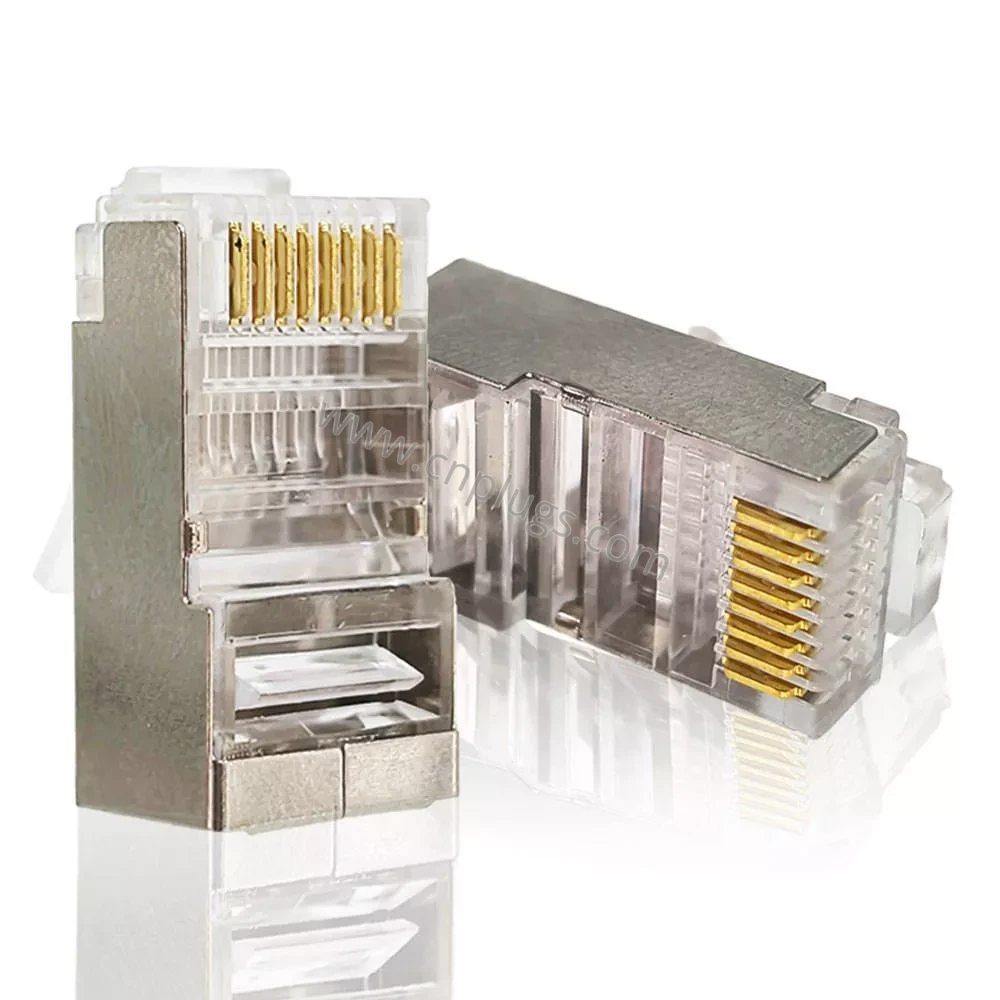
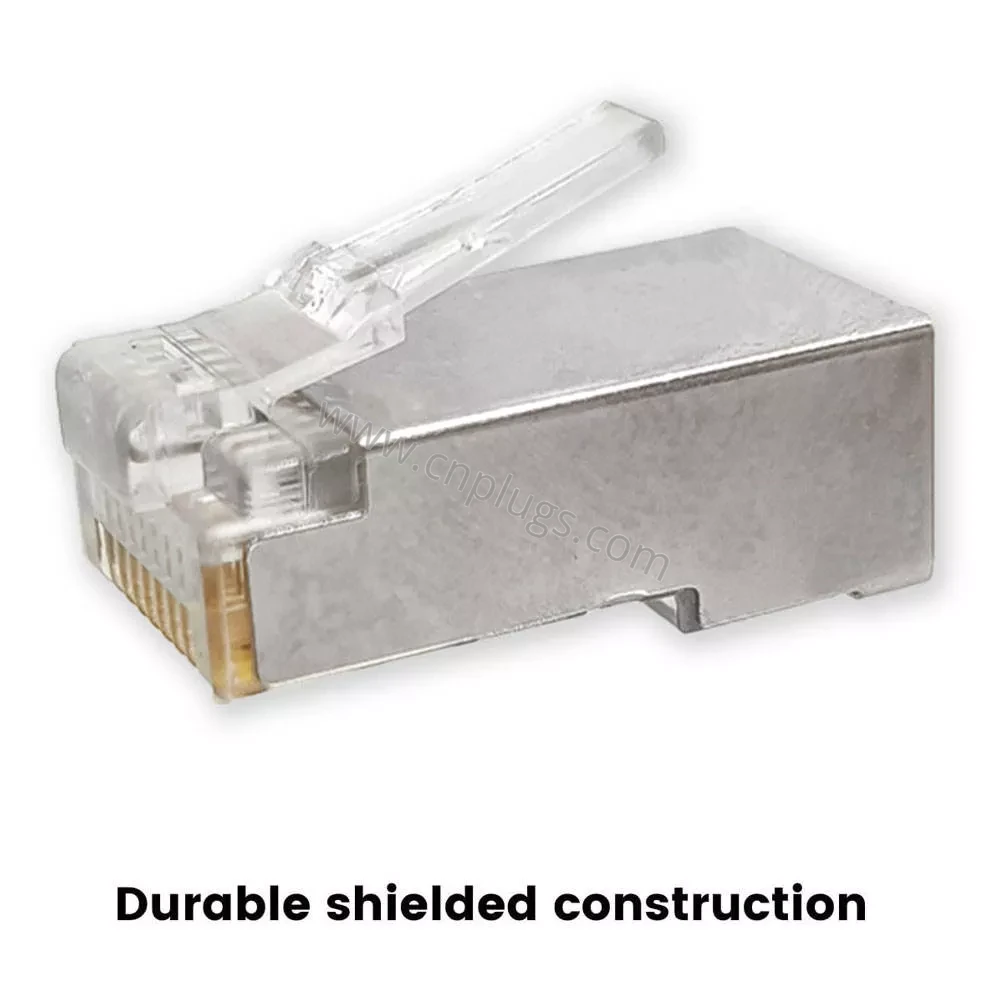
This plug carries a nickel-plated copper-alloy shell that encloses the connector body and makes contact with the shell of the mating jack. The shell is not decoration and it is not a plating on plastic: it is a conductive enclosure that intercepts electromagnetic interference and routes it to ground rather than allowing it to couple into the four data pairs. Rear crimp wings clamp the cable foil and drain wire against the shell so the shield path runs continuously from the cable, through the plug, into the jack and out to the rack or chassis ground.
The purchasing consequence is straightforward: a shielded cable specification obliges a shielded connector specification. If a project drawing calls for Cat5e F/UTP or S/FTP and the BOM lists an unshielded plug, the installed system does not deliver the performance that was bought, because the shield terminates in mid-air. This is one of the most common line-item mismatches we see in customer BOMs, and it is worth a five-second check before release. The installation-side detail — grounding at one end or both, bonding practice, why an unshielded plug on shielded cable is worse than no shield at all — is covered in depth on our Cat5e shielded RJ45 connector page written for installers. Same part, different question; send your field teams there.
Contacts, Metallurgy and What Actually Fails in Volume Production
The eight contacts are phosphor bronze — a copper alloy — plated with 50 microinches of gold over a 100 microinch nickel barrier. We describe the material honestly rather than advertising “99.99% pure copper pins” as several competitors do, because pure copper is too soft to hold spring temper or to pierce conductor insulation reliably. It is the wrong metal for the job, and any buyer with a materials background knows it. What you want in an insulation displacement contact is a hardened copper alloy: pure copper alloy (phosphor bronze) — never iron or steel-plated stock, which rusts and loses spring force within months in humid environments.
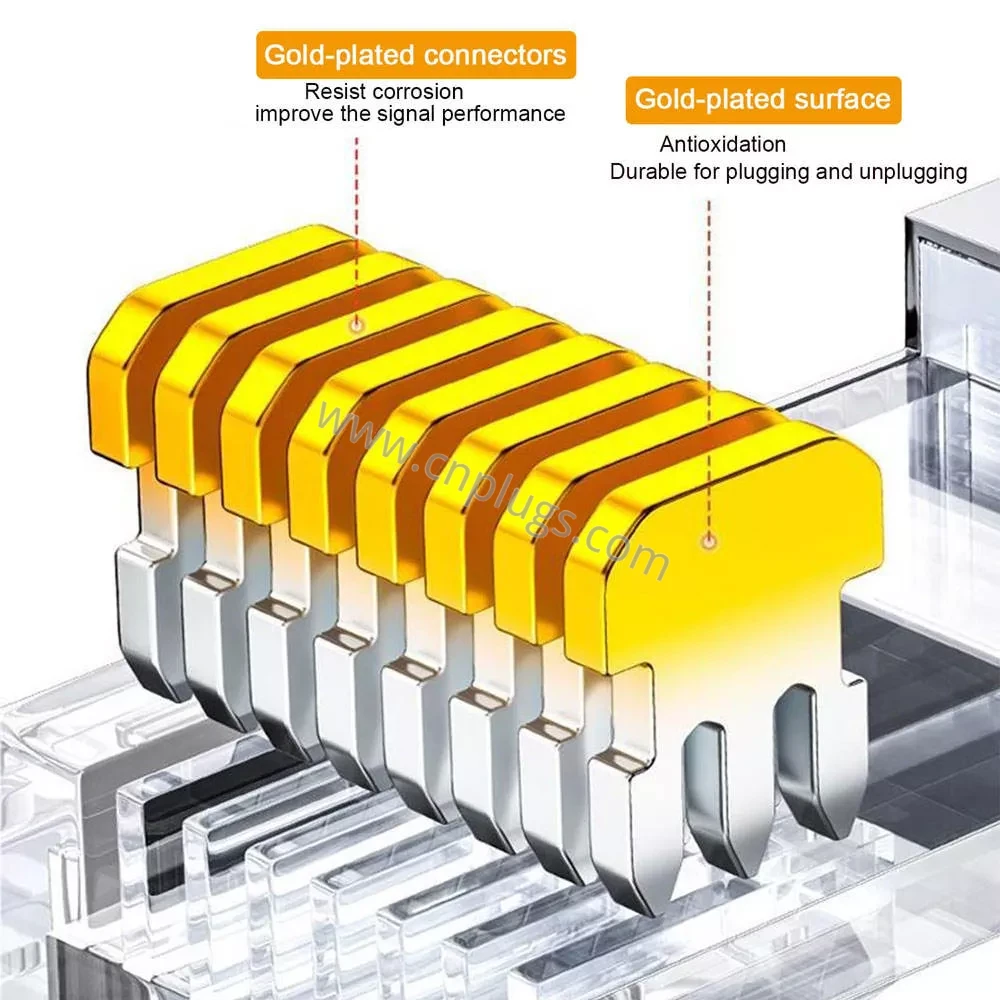
The nickel underlayer matters as much as the gold. Gold plated directly onto bronze allows copper to migrate into the gold over time and oxidise at the surface; the nickel barrier stops that diffusion, which is why 50µ” gold over 100µ” nickel survives 750 mating cycles and 48 hours of salt spray while a flash-plated contact degrades in a fraction of that. For high-cycle applications — test benches, demo racks, frequently repatched cross-connects — that is the difference between a connector that lasts the life of the installation and a warranty return.
Each contact has three insulation-displacement prongs rather than the two used in many bulk-packed plugs. Three piercing points give a larger, more redundant gas-tight contact area and tolerate the small variations in insulation thickness found across cable brands and production lots. In an assembly house running thousands of terminations a shift, that tolerance is what keeps the continuity-test failure rate low.
Fitment: The Specification That Determines Whether Your Line Runs
Externally, modular plugs are dimensionally standardised — they have to be, or nothing would mate with anything. The mechanical envelope is governed by the modular interface dimensions in FCC Part 68 and the corresponding TIA dimensional standards, and we gauge-check body width, latch geometry and contact height every production shift. Internally is where plugs differ, and where purchasing decisions are actually made.
The governing internal dimension is the insulated conductor diameter, not the category printed on the cable jacket. Cat5e cable from different mills varies in insulation wall thickness and jacket construction, and a plug whose wire channels are 0.05 mm too small will not accept the conductors to the front stop — which means the contacts pierce short of the copper and the link fails intermittently. Too large, and the conductors float and the crimp is unreliable. This plug is dimensioned for 24–26 AWG conductors at 0.90–1.05 mm insulated outside diameter, with a shielded jacket entry up to 6.5 mm, since shielded jackets run measurably thicker than unshielded. Send us a metre of the cable you intend to terminate before you place a volume order. We measure it and confirm fitment in writing; that single step eliminates the most expensive failure mode in connector procurement.
Technical Specifications
| Parameter | Specification |
|---|---|
| Model No. | PR-C5ES-8P8C (Cat5e shielded 8P8C modular plug) |
| Connector Type | 8P8C modular plug, all 8 positions loaded (RJ45-style) |
| Category / Standard | Cat5e, ANSI/TIA-568.2-D, ISO/IEC 11801 Class D |
| Wiring Schemes | T568A and T568B compatible |
| Mechanical Interface | Modular plug envelope per FCC Part 68 / TIA dimensional requirements |
| Shielding | Fully shielded — nickel-plated copper-alloy shell, 360° coverage |
| Shield Termination | Rear crimp wings onto foil + drain wire; shell-to-jack spring contact |
| Compatible Cable | Cat5e STP, FTP, F/UTP, U/FTP, S/FTP (solid and stranded) |
| Contact Material | Pure copper alloy / phosphor bronze |
| Contact Plating | 50µ” gold over 100µ” nickel (3µ” / 15µ” / 30µ” optional) |
| IDC Prongs | 3-prong, solid & stranded compatible |
| Housing Material | 100% virgin polycarbonate insert, UL 94V-0 |
| Bandwidth | 100 MHz |
| Data Rate | 1000BASE-T Gigabit Ethernet |
| Conductor Size | 24–26 AWG; insulated OD 0.90–1.05 mm |
| Cable Jacket OD | Up to 6.5 mm |
| Current Rating | 1.5 A per contact (PoE / PoE+ / PoE++ 802.3bt, 90 W) |
| Voltage Rating | 150 V AC (rms) |
| Contact Resistance | ≤ 20 mΩ |
| Shell-to-Shell Resistance | ≤ 50 mΩ |
| Insulation Resistance | ≥ 500 MΩ @ 500 V DC |
| Dielectric Strength | 1000 V AC / 1 minute, no breakdown |
| Durability | ≥ 750 mating cycles |
| Salt Spray | 48 hours, no visible corrosion |
| Operating Temperature | -40 °C to +85 °C |
| Required Tool | Standard 8P8C crimp tool (non-pass-through) |
| Compliance | RoHS, REACH, ISO 9001, UL-recognised material |
| Documentation | 2D drawing, datasheet, RoHS/REACH declarations, material certs, Fluke DSX-8000 reports |
| Packaging | 100 pcs/bag, 50/100 pcs jar, blister card, OEM carton |
| MOQ / Lead Time | Stock from 1,000 pcs; custom logo from 10,000 pcs; 7–15 days |
Buying Direct From the Factory: Documentation, Consistency and Scale
Most shielded 8P8C plugs sold online arrive through two or three intermediaries, and each layer removes information. When a distributor cannot tell you the nickel underplate thickness, the insert resin grade or which lot a shipment came from, that is not evasion — they genuinely do not know. Buying from the manufacturer restores that visibility. We hold 50 million pieces per month of capacity, run ISO 9001 process control, and can trace any shipment to its production lot, mould cavity and plating batch. If a problem appears at your line, we can identify what changed rather than guessing.
Consistency across lots is the specification that matters most in volume assembly and the one least often stated on a datasheet. A plug that fits perfectly in January and marginally in June will quietly raise your scrap rate and your rework labour long before anyone declares a quality incident. Dedicated tooling, controlled resin sourcing (Japanese PC from Teijin and Covestro) and in-line dimensional checks are how we hold it. For programmes with a fixed annual volume we will reserve mould capacity and hold safety stock against your forecast.
Custom Logo, Private Label and OEM Programmes
Custom moulds and private labelling are standard services here, not exceptions. We produce logo-marked shells from 10,000 pieces, print your artwork on bags, jars, blister cards and cartons, apply your barcodes and part numbers, and can ship in your packaging directly to your customer under a blind arrangement. Plating thickness, contact configuration, jacket entry diameter and shell finish can all be tuned to a programme specification — see our custom logo Cat5e OEM plug for the unshielded equivalent, and browse the full standard Cat5e and Cat6 modular plug range for adjacent part numbers you may want on the same order. Free samples ship to qualified buyers; send us your drawing or your cable specification and we will quote against it.
Frequently Asked Questions
Is an 8P8C connector the same as an RJ45 connector?
In everyday commercial use, yes — they refer to the same part, and we label this product both ways. Technically, 8P8C describes the physical eight-position, eight-contact connector, while RJ45 is a Registered Jack wiring designation whose original form (RJ45S) was a keyed eight-position, two-contact telephone part. Ethernet uses the 8P8C connector wired to T568A/T568B per ANSI/TIA-568. If your engineering documentation requires the structurally accurate term, specify “8P8C modular plug, shielded, Cat5e”; our drawing carries both designations.
Does this plug support both T568A and T568B?
Yes. Wiring scheme is determined by the order in which you insert the conductors, not by the plug. The same part terminates either standard. What matters is consistency at both ends of a link — mixing schemes on one cable produces a crossover, which modern auto-MDI-X switches will usually tolerate but which will fail a certification test against the specified scheme.
What is the difference between 8P8C and 8P4C?
Position count is identical; contact count is not. An 8P4C plug has the same eight-position body with only the middle four contacts loaded, and is used for four-conductor applications where the housing must still fit an eight-position jack. It cannot carry Gigabit Ethernet, which requires all four pairs. This product is a true 8P8C with every position populated. For four-contact applications see our 8P4C modular plug.
Will this plug work with Cat6 cable?
Sometimes, but do not specify it that way. Cat6 conductors are typically 23 AWG with a thicker insulation wall, and many Cat6 cables exceed the 1.05 mm insulated conductor diameter this plug accepts. Fitment is decided by measured conductor and jacket dimensions, not by the category printed on the jacket. For Cat6 shielded work, order the Cat6 shielded plug with a 1.2 mm wire hole, which is dimensioned for it.
Can I use these on solid conductor cable, or only stranded patch cable?
Both. The 3-prong IDC contact geometry is designed to straddle and grip solid conductors as well as bite into stranded bundles, which is why we use it across the range. Note the general structured-cabling recommendation: permanent horizontal runs in solid copper are best terminated into keystone jacks or field-termination plugs, with 8P8C plugs used for patch cords and for unavoidable direct terminations such as PoE cameras and access points. Where a field termination is preferable, see our toolless shielded field termination plug.
Do I need a special crimp tool?
No. This is a standard non-pass-through 8P8C plug and it crimps with any quality 8P8C tool. Conductors must be trimmed to length and inserted to the front stop before crimping. If you prefer to feed the conductors through the nose and trim flush — faster and easier to verify in the field — choose a feed-through part instead; those require a pass-through crimper with a flush-cut blade.
Does the metal shell affect Power over Ethernet?
No. Power over Ethernet travels on the same pairs the contacts terminate, and each contact here is rated 1.5 A, covering 802.3af, 802.3at and 802.3bt up to 90 W. A shielded assembly generally handles PoE thermal load better than an unshielded one, because the metal shell and the cable shield provide an additional path for heat to leave the bundle.
What documentation ships with an order?
A 2D dimensional drawing, the product datasheet, RoHS and REACH declarations, material certificates for the insert resin and contact alloy, and Fluke DSX-8000 channel test reports. Anything else your quality system requires — first-article inspection reports, PPAP-style submissions, lot traceability records — we can prepare on request. Tell us at quotation stage so it is built into the schedule rather than chased afterwards.
What are your minimum order quantity and lead time?
Stock part numbers ship from 1,000 pieces. Custom logo shells start at 10,000 pieces. Standard lead time is 7 to 15 days depending on plating specification and packaging. Free samples are available to qualified buyers; contact our team with your target volume and cable specification and we will send samples with the matching drawing.
 WeChat ID: