
Cat5e Shielded RJ45 Connector: FTP/STP 8P8C Modular Plug with a Continuous Metal Shield Path, Direct From the Factory
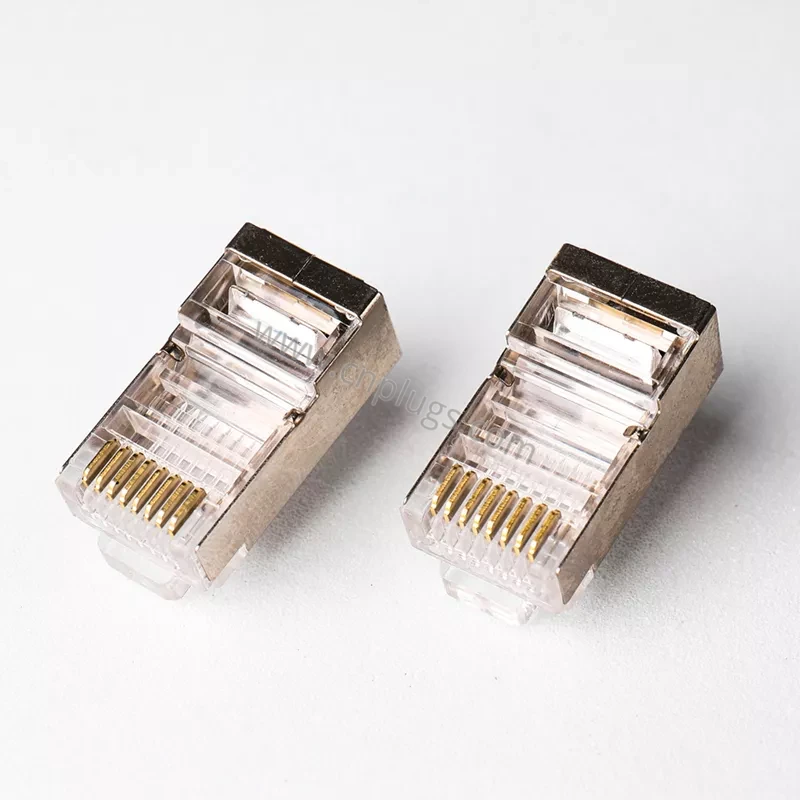
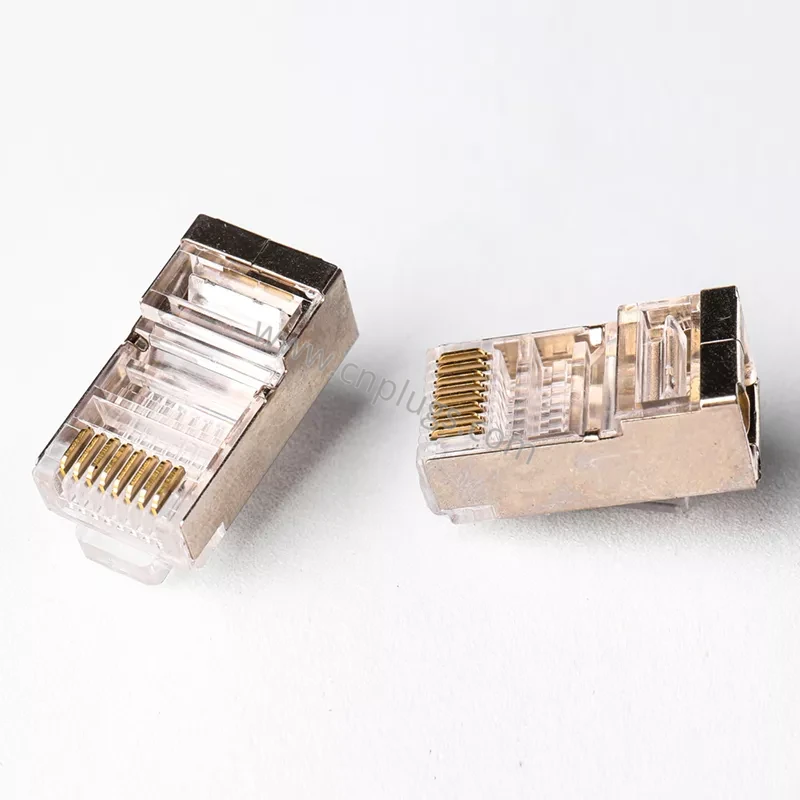
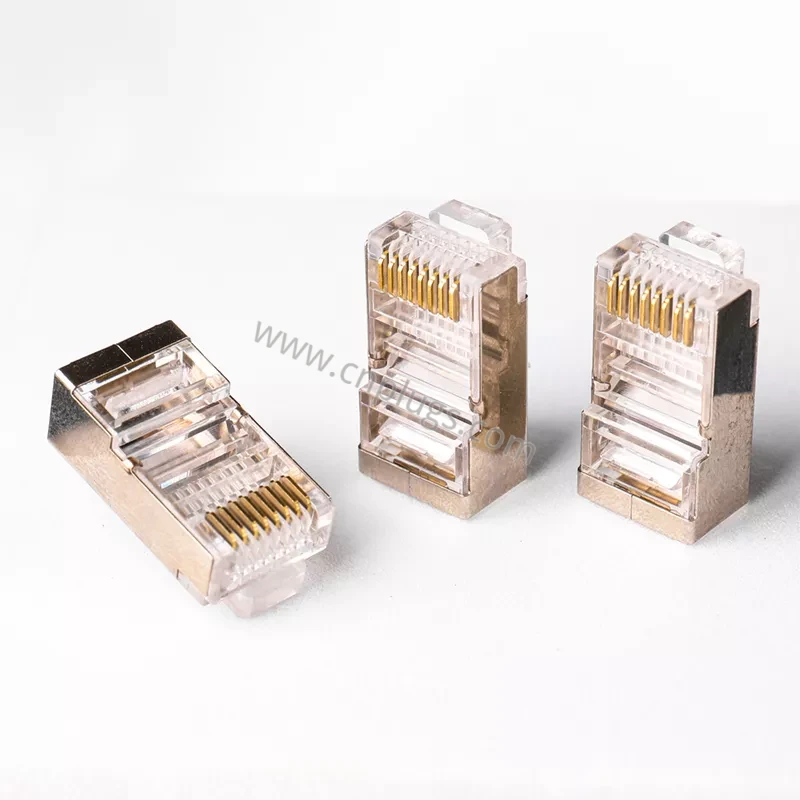
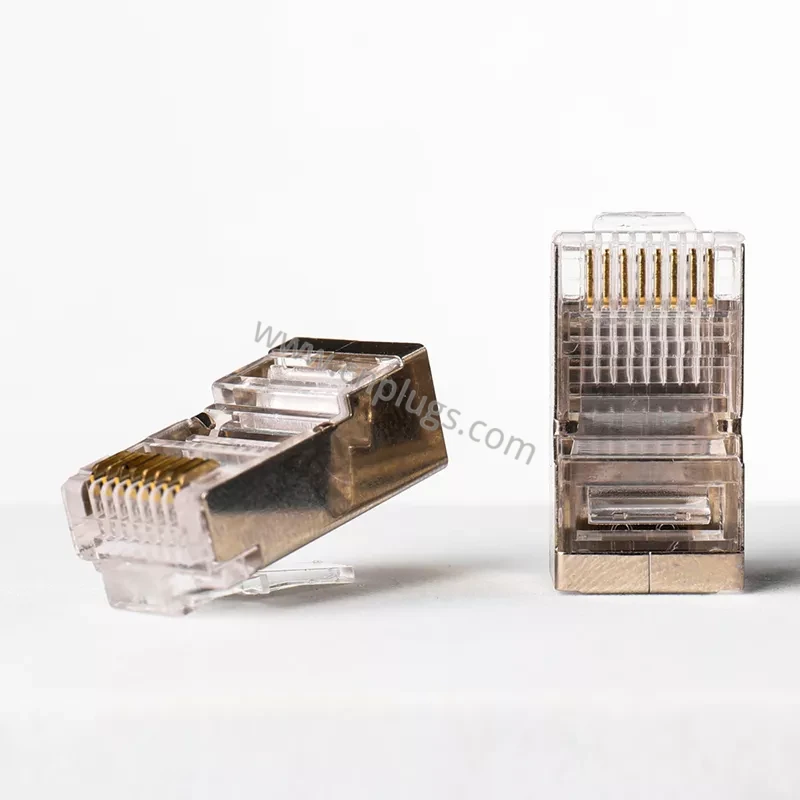
The Prounta Cat5e shielded RJ45 connector is an 8P8C modular plug built inside a nickel-plated metal shell, designed to terminate FTP, U/FTP, S/FTP and STP Cat5e cable without breaking the one thing that makes shielded cable worth buying: shield continuity. Shielded cable costs more per metre, takes longer to pull and demands a grounded rack — and every bit of that investment is cancelled the moment someone crimps a plastic UTP plug onto the end of it. This connector is the part that keeps the shield electrically continuous from cable foil, through the plug shell, into the jack and out to building ground. It pairs that shell with pure copper alloy contacts, 50µ” gold plating and three-prong IDC blades, and it ships direct from our own factory floor with no trading-company margin in between.
Shielded or Unshielded? The Rule That Decides It
The most common question we receive is whether a shielded plug is really necessary. The answer follows one asymmetric rule that installers learn the hard way. Putting a shielded plug on unshielded cable is harmless but achieves nothing, because there is no foil or drain wire for the shell to bond to. Putting an unshielded plug on shielded cable is a genuine fault: the foil terminates at nothing, the drain wire is clipped off, and the shield becomes an unterminated conductor that can behave as an antenna and pick up more noise than it rejects. That is why a badly terminated shielded run frequently performs worse than plain UTP would have. If the cable on the drum says FTP, STP, F/UTP, U/FTP or S/FTP, the plug must be shielded — no exceptions. Specify shielded Cat5e wherever cable runs parallel to power conduit, through plant rooms, near motors, VFDs, lift machinery, LED drivers or radio equipment, or across hospital and broadcast environments. For general office drops in clean environments, our unshielded Cat5e UTP RJ45 connector remains the economical choice. Background reading on cable construction is available at Twisted pair.
How the Shield Path Is Maintained Inside This Plug
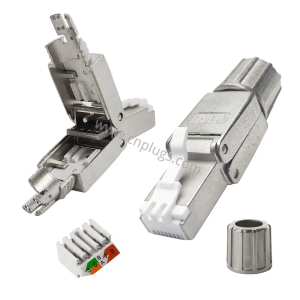
A shielded plug is only as good as its bonding path, and this is where cheap shielded plugs quietly fail. Our shell is drawn from copper alloy and nickel-plated for corrosion resistance and low-impedance contact, and it wraps the full length of the plug body rather than covering only the nose. At the rear, two crimp wings close onto the cable jacket and clamp the foil and drain wire directly against the inside of the shell, so the bond is mechanical and gas-tight rather than dependent on incidental contact. When the plug is inserted, the shell mates with the spring fingers of a shielded jack or patch panel, which carries the shield to the panel frame and on to the rack earth bar. The result is one continuous conductive path with no interruption at the connector. Grounding practice matters just as much as hardware: for Ethernet patching, the shield should be bonded at both ends through the connector shells and referenced to the same building ground via equipment chassis, which avoids the ground loops caused by improvised pigtails and inconsistent bonding. See Shielded cable for the underlying principle. Where an existing shielded run has to be terminated in the field without a crimper, our toolless zinc-alloy shielded field-termination plug is the faster option.
Contacts, Metallurgy and the Two-Prong Problem
Inside the shell, the electrical work is done by eight stamped blades. Ours are pure copper alloy — phosphor bronze — nickel-plated and finished with 50µ” hard gold. We state the alloy precisely rather than advertising “99.99% pure copper” pins the way several bulk-packed shielded plugs do, because genuinely pure copper is too soft to hold spring temper or pierce conductor insulation; phosphor bronze is the correct IDC material and always has been. The claim that actually matters is that the base metal is a real copper alloy through the full section, not iron or steel with a copper flash that rusts and loses tension. Equally important is prong count: many shielded Cat5e plugs sold in hundred-piece bags use a two-prong contact, which pierces the conductor at two points. Ours uses three, giving three independent contact points per wire and materially better resistance to vibration and thermal cycling — the same construction used across our standard Cat6 and Cat5e plug range.
Technical Specifications
| Parameter | Specification |
|---|---|
| Model No. | PR-C5ES-01 (Cat5e shielded, FTP/STP) |
| Category / Standard | Cat5e, ANSI/TIA-568.2-D, ISO/IEC 11801 Class D |
| Configuration | 8 Position 8 Contact (8P8C), one-piece, no load bar required |
| Shielding | Fully shielded — nickel-plated copper-alloy metal shell, 360° coverage |
| Shield Termination | Rear crimp wings onto cable foil + drain wire; shell-to-jack spring contact |
| Compatible Cable | Cat5e FTP, F/UTP, U/FTP, S/FTP, STP (solid and stranded) |
| Contact Material | Pure copper alloy / phosphor bronze |
| Contact Plating | 50µ” gold over nickel (3µ” / 15µ” / 30µ” optional) |
| IDC Prongs | 3-prong, solid & stranded compatible |
| Housing Material | 100% virgin polycarbonate insert, UL 94V-0 |
| Bandwidth | 100 MHz |
| Data Rate | 1000BASE-T Gigabit Ethernet |
| Conductor Size | 24–26 AWG; insulated OD 0.90–1.05 mm |
| Cable Jacket OD | Up to 6.5 mm (shielded jackets run thicker than UTP) |
| Current Rating | 1.5 A per contact (PoE / PoE+ / PoE++ 802.3bt, 90 W) |
| Voltage Rating | 150 V AC (rms) |
| Contact Resistance | ≤ 20 mΩ |
| Shell-to-Shell Resistance | ≤ 50 mΩ (shield continuity verified) |
| Insulation Resistance | ≥ 500 MΩ @ 500 V DC |
| Dielectric Strength | 1000 V AC / 1 minute, no breakdown |
| Durability | ≥ 750 mating cycles |
| Salt Spray | 48 hours, no visible corrosion |
| Operating Temperature | -40 °C to +85 °C |
| Compliance | RoHS, REACH, ISO 9001, UL-recognised material |
| Packaging | 100 pcs/bag, 50/100 pcs jar, blister card, OEM carton |
| MOQ / Lead Time | Stock from 1,000 pcs; custom logo from 10,000 pcs; 7–15 days |
Factory Direct: What It Changes for Your Purchase Order
This plug is manufactured in our own plant — stamping, plating, injection moulding, assembly and testing under one roof — and sold to you directly. In practice that means three things a trading company cannot offer. Price is quoted from the production cost, without the layer of margin that sits between a Chinese exporter and its supplier. Engineering questions are answered by the people who own the tooling, so a request for a different bore, shell finish, plating thickness or contact geometry becomes a drawing rather than a refusal. And quality is traceable: every batch ships with its own Fluke DSX-8000 test report, and non-conformities are corrected at the source instead of being negotiated between intermediaries. Volume buyers can audit the line. Compare the same manufacturing basis on our Cat6A STP/FTP shielded modular plug and across the full Cat6A and Cat8 shielded range.
Custom Logo, Private Label and OEM Packaging
Distributors and cabling brands ship this connector under their own name. Options include laser marking and mold-engraved logos, custom shell finishes, and complete retail packaging — poly bags, screw-top jars, blister cards, colour boxes and master cartons carrying your barcode and SKU. Artwork and 3D renderings are approved before any tooling is cut. See comparable private-label work on our custom logo Cat5e RJ45 connector and the pure copper connector free-sample programme.
Frequently Asked Questions
Can I use an unshielded RJ45 connector on shielded Cat5e cable? No. The foil and drain wire would terminate at nothing, breaking shield continuity and leaving an unterminated conductor that can pick up noise rather than reject it. Shielded cable requires shielded plugs, shielded jacks and a shielded patch panel end to end.
Can I use a shielded connector on unshielded UTP cable? Physically yes, and it causes no harm, but there is no benefit — with no foil or drain wire to bond to, the shell is electrically floating. Use the unshielded version and save the cost.
Should the shield be grounded at one end or both? For Ethernet patch and horizontal links, bond at both ends through the connector shells into shielded jacks and panels, all referenced to the same building ground through equipment chassis. Problems attributed to “ground loops” usually come from improvised pigtails or inconsistent bonding across a site, not from bonding both ends of a compliant link. Follow the project grounding design where one exists.
Does the metal shell affect PoE? No. Shielding does not impede Power over Ethernet; the plug is rated 1.5 A per contact and supports 802.3af/at/bt to 90 W. In dense bundles, manage heat through bundle size and cable gauge as usual.
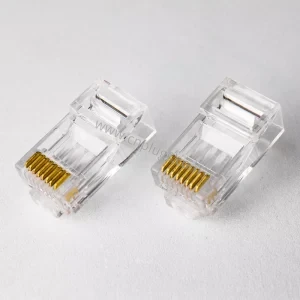
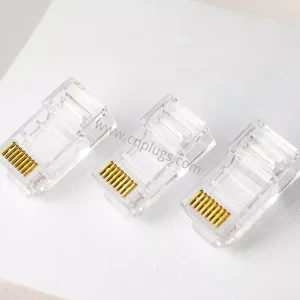
How do I tell a shielded plug from an unshielded one? Look at the body: a shielded plug has a metal shell, usually silver-toned, often with rear crimp wings for the drain wire. An unshielded plug is entirely clear plastic.
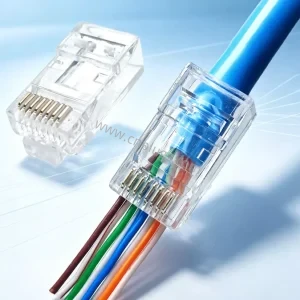
Will these fit thicker shielded jacket? They accept jackets up to 6.5 mm, which covers standard shielded Cat5e. For heavier Cat6 and Cat6A shielded cable, use the larger bore of our pass-through shielded range, which also lets you verify wire order before crimping.
Do you provide free samples? Yes. Verified business buyers receive a free sample kit and pay courier cost only, credited against the first order. Contact our engineering team for samples, drawings, factory audit arrangements or bulk pricing, or browse the full RJ45 connector catalogue.
 WeChat ID: