
An RJ45 modular plug may look like a commodity, but it is a performance-sensitive part of a copper Ethernet channel. A plug that fits physically can still cause an open circuit, unstable Power over Ethernet, excessive crosstalk, poor return loss or intermittent contact. Selecting only by price and category label increases termination failures, rework and warranty cost.
This manufacturer-focused guide covers cable fit, Cat5e through Cat8 performance, shielding, conductor compatibility, contacts, plating, termination structures, production control and certification testing. It also provides a supplier-audit framework for distributors, cabling brands, patch-cord factories and contractors.
What Is an RJ45 Modular Plug?
The connector commonly called an RJ45 plug is physically an 8-position, 8-contact modular plug, written as 8P8C. The terms are used interchangeably in networking, although their formal definitions differ. The plug terminates four twisted pairs and mates with Ethernet jacks in switches, patch panels, outlets and devices.
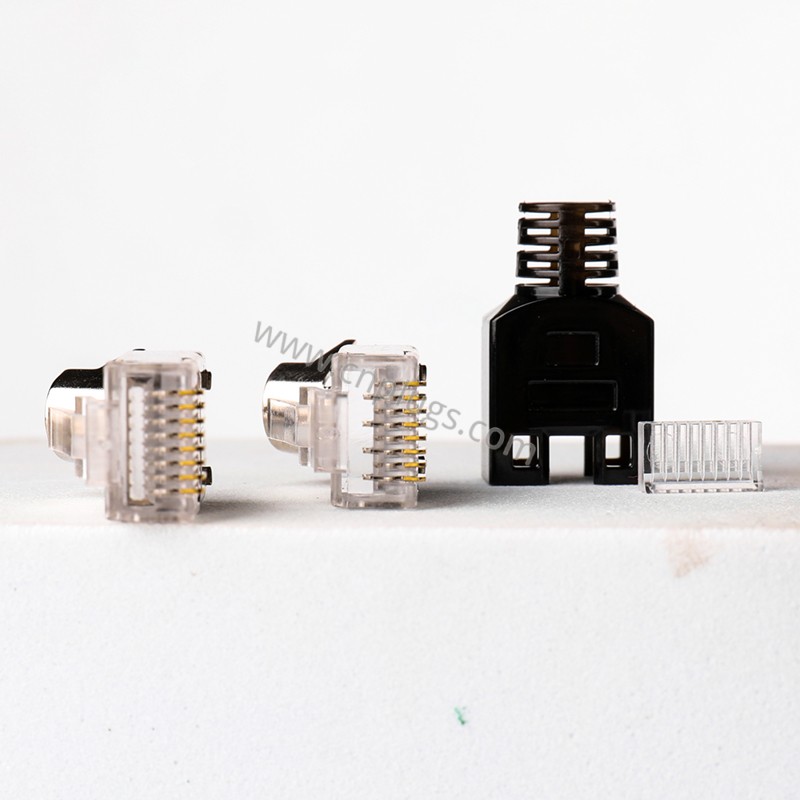
A typical plug includes a polycarbonate housing, eight contacts and a latch. Some designs add a load bar, shield shell, ground tab, clamp or boot. External dimensions appear standardized, but internal conductor channels vary; two plugs labeled “Cat6” may not fit the same cable.
For background on connector terminology, see Wikipedia’s modular connector overview. Buyers can also review PROUNTA’s complete RJ45 connector catalog to compare physical structures.
Why Cable-to-Plug Fit Matters More Than the Category Printed on the Bag
The most important sourcing principle is simple: category is a performance target, not a complete fit specification. Before selecting a plug, obtain the cable’s construction data and tolerance range. At minimum, the connector supplier needs five values:
- Cable jacket outside diameter in millimeters.
- Insulated conductor diameter, including copper and insulation.
- Conductor gauge in AWG.
- Solid or stranded conductor construction.
- Shielding type, such as U/UTP, F/UTP, U/FTP or S/FTP.
AWG alone is insufficient. Two 23 AWG cables can have different insulation, separators and jacket diameters. Undersized conductor holes impede insertion; oversized holes can misalign copper and contact blades. If the jacket cannot enter the rear opening, strain relief is ineffective. Select nominal cable dimensions near the middle of the plug’s range to allow for production tolerances.
RJ45 Connector Categories: Cat5e, Cat6, Cat6A, Cat7 and Cat8
| Category | Nominal Bandwidth | Typical Ethernet Application | Connector Considerations |
|---|---|---|---|
| Cat5e | 100MHz | 1000BASE-T up to a 100m channel | Commonly 24–26 AWG; compact UTP or shielded plugs |
| Cat6 | 250MHz | 1Gbps to 100m; 10GBASE-T over qualified shorter channels | Larger conductors; straight or staggered load-bar designs |
| Cat6A | 500MHz | 10GBASE-T up to a 100m channel | Tighter NEXT/return-loss control; often larger and shielded |
| Cat7 / Class F | 600MHz | 10Gbps in ISO/IEC systems | Verify connector interface and channel claim; “Cat7 RJ45” marketing is not enough |
| Cat8 / Class I | 2000MHz | 25GBASE-T or 40GBASE-T up to a 30m channel | Shielded 8P8C, large cable fit and tightly controlled termination |
A higher-category plug does not upgrade lower-category cable. Performance is limited by the lowest-rated component and installation quality. A connector may mate physically while failing its advertised electrical limits. Request a report for the exact plug, cable and termination rather than a generic family certificate.
Cat5e and Cat6 remain practical for standard networks. Cat6A supports full-distance 10 Gigabit Ethernet and enterprise upgrades. Cat8 is specialized for short, shielded data-center channels, not ordinary office cabling.
Shielded vs. Unshielded RJ45 Plugs
Unshielded Plugs
Unshielded RJ45 connectors use a molded plastic body without a conductive shell. They are typically paired with U/UTP cable in homes, offices and other environments where pair balance and twist provide adequate noise immunity. They cost less, install quickly and do not require a grounding path.
Shielded Plugs
Shielded connectors add a metal enclosure that bonds cable foil, braid or drain conductor to mating hardware. Shielding does not create bandwidth; it maintains continuity and controls interference and alien crosstalk within a properly bonded system.
Match shielded plugs with shielded cable and grounded equipment. An unshielded plug breaks the shield path, while a metal plug on UTP offers no shielding benefit and may not fit. For noisy environments, compare PROUNTA’s Cat6A and Cat8 shielded RJ45 connectors.
Solid vs. Stranded Conductors and 2-Prong vs. 3-Prong Contacts
Solid conductors use one copper wire and are common in horizontal cable. Stranded conductors use fine strands for patch-cord flexibility. Contact geometry must be validated for the chosen construction.
Two-prong contacts commonly serve stranded conductors. Three-prong contacts can straddle solid copper and may support both types, but prong count alone proves nothing. Contact spacing, hardness, depth and cable dimensions must work together. Specify conductor compatibility and verify it with the intended cable.
Poor alignment can create resistance and heat, especially with PoE. Inspect terminated samples and confirm that all eight blades engage copper without cutting or displacing it.
Standard, Two-Piece, Pass-Through and Toolless RJ45 Connectors
Standard One-Piece Plug
A closed-end one-piece plug is compact and economical. Conductors are arranged, trimmed and inserted to the nose. It works well with matched cable and trained operators, although wire order and insertion depth are harder to verify after loading.
Two-Piece Plug with Load Bar
A load bar organizes conductors before housing insertion. Straight and staggered layouts are available; staggering creates space for larger insulation and controls pair geometry. Short-body versions suit compact enclosures, while larger shielded plugs may include an external clamp.
Pass-Through Plug
A pass-through connector exposes conductors at the front for T568A/T568B and depth inspection. A compatible tool crimps and cuts them flush, improving speed and reducing wire-order errors. Mismatched blades, incomplete trimming or copper protrusion cause failures. Browse PROUNTA’s pass-through RJ45 plugs.
Toolless Field Termination Plug
Toolless plugs use a conductor manager, hinged housing and IDC or PCB structure instead of a crimp die. They accept larger cable, can often be reopened and suit field installation or MPTLs. Because they cost more and occupy more space, verify port density and clearance. See PROUNTA’s tool-free connectors.
Gold Plating: What It Does and What It Does Not Do
Gold plating protects mating surfaces from corrosion and wear while stabilizing contact resistance. Options include flash, 3µin, 6µin, 15µin, 30µin and 50µin over nickel. Thicker hard gold provides more margin for humidity and frequent mating.
Thickness does not directly increase bandwidth. A poorly designed 50µin plug can still fail NEXT or return loss. Specify plating by durability and certification needs, verify it through X-ray fluorescence and define whether thickness applies to the functional contact zone or entire blade.
The supplier should document base metal, nickel underplate and consistency. PROUNTA offers configurable plating across its standard Cat5e and Cat6 plugs.
Housing, Shield and Strain-Relief Materials
Transparent housings are normally polycarbonate. Virgin resin, controlled moisture and stable molding temperature support accurate dimensions and durable latches. UL 94 V-0 or V-2 describes flammability, not Ethernet category performance.
Shield shells may use brass, copper alloy, steel or zinc alloy. Material affects forming, corrosion, continuity and retention. Clamps should grip the jacket or shield without crushing pair geometry. RJ45 strain relief boots protect latches and bending but cannot correct a poor crimp.
T568A and T568B Wiring
T568A and T568B define accepted pair assignments. Performance is equivalent when one scheme is used consistently. Mixing them creates a crossover that project documentation may not allow.
Work instructions should show contact numbering from the correct orientation, use color images, limit pair untwist and require first-piece approval. A wire-map tester finds opens, shorts, reversals and split pairs but cannot certify category performance.
How a Professional RJ45 Connector Factory Controls Quality
Incoming Material Inspection
Quality begins with resin identity, moisture, contact-strip composition, shell thickness and plating chemistry. Verify critical dimensions and retain certificates by lot. Mixed resin changes shrinkage and latch durability; variable strip hardness changes IDC penetration.
Precision Stamping and Injection Molding
Contacts require controlled burr direction, pitch, flatness and height. Tight housing dimensions support smooth mating. Mold wear, flash and gate variation can alter conductor holes or latch behavior despite acceptable appearance.
Plating and Assembly Control
Measure nickel and gold with calibrated XRF equipment. Fixtures must control contact depth and shield alignment. Vision inspection detects missing contacts, bent blades and deformed shells. OEM programs also require lot identity and change control.
Mechanical and Electrical Verification
Checks include dimensions, mating force, retention, latch flex, cable pull, cycles, contact resistance, insulation resistance and dielectric withstand. Programs may add aging, humidity or salt spray. Methods, limits and sampling belong in the control plan.
Network Performance Testing: Wire Map Is Only the Beginning
A continuity tester cannot prove Cat6, Cat6A or Cat8 performance. Certification measures insertion loss, NEXT, power-sum NEXT, return loss, ACR-F, delay and skew. Shielded and PoE systems may also require shield integrity, loop resistance and resistance unbalance.
Test configuration must match the product. Patch cords require category-matched patch-cord adapters. Channel and permanent-link tests evaluate different boundaries. An MPTL uses a permanent-link adapter and a patch-cord adapter so the final plug is included. Fluke Networks explains this in testing crimp-style and field-terminated plugs.
PROUNTA supports Fluke DSX testing for matched cable-and-plug assemblies. Define the component, patch-cord, channel or MPTL limit before approval; one passing configuration does not prove every use.
PoE Requirements for RJ45 Modular Plugs
PoE adds DC current to data contacts. Suitability depends on resistance, plating, conductor size, crimp consistency, temperature rating and bundle design. “PoE compatible” alone is insufficient for high-power projects.
For PoE++, request the standard reference, current or temperature test, resistance-unbalance results and validation cable. Use compliant solid copper, not copper-clad aluminum. Avoid disconnecting loaded links unless designed for applicable make-and-break conditions, because arcing can damage contacts.
Standards and Certifications Buyers Should Understand
- ANSI/TIA-568.2-D: Balanced twisted-pair cabling and connecting-hardware performance in TIA systems.
- ISO/IEC 11801: Generic cabling classes and channel architecture used internationally.
- IEC 60603-7 series: Mechanical and electrical requirements for 8-way connectors at different performance levels.
- IEC 61935-2: Testing of balanced patch cords and work-area cords.
- ANSI/TIA-1096-A: Mechanical, contact and interface requirements relevant to modular connectors.
- UL 94: Flammability classification; not a data-performance certificate.
- RoHS and REACH: Substance restrictions and chemical compliance; not proof of bandwidth.
Always verify scope. A resin UL file does not mean the finished plug is UL Listed, and a generic RoHS declaration does not prove the exact production lot passed category testing.
A Seven-Step RJ45 Plug Selection Workflow
- Define the application: Identify required Ethernet speed, channel type, PoE level, environment and target standard.
- Record cable dimensions: Measure jacket OD and insulated conductor OD, then confirm AWG, tolerance, solid or stranded construction and round or flat profile.
- Match shielding: Pair UTP cable with an unshielded plug or select a shielded plug that bonds correctly to the foil, braid or drain wire.
- Select termination architecture: Choose one-piece for economy, a load bar for organized conductors, pass-through for visual verification or toolless construction for field termination.
- Confirm the tool: Check die dimensions, pass-through blade position and shield-crimp capability. Similar tools may produce different contact heights.
- Approve samples: Terminate production cable, inspect engagement, test pull and continuity, and record yield.
- Certify the assembly: Apply the relevant patch-cord, channel, component or MPTL limit before volume production.
This sequence prevents a common procurement mistake: approving the plug first and attempting to force an existing cable and crimper to work later. Treat connector, cable, tool and test limit as one system.
Common RJ45 Termination Failures and Their Root Causes
| Observed Failure | Likely Cause | Corrective Action |
|---|---|---|
| Open conductor | Wire not fully seated, wrong contact geometry or insufficient crimp height | Check insertion depth, cable fit and tool adjustment |
| Intermittent link | Blade beside the copper, damaged strands or weak strain relief | Inspect a cross-section and repeat pull/flex testing |
| Poor NEXT margin | Excessive pair untwist, unsuitable load bar or uncontrolled conductor geometry | Shorten untwist and validate a category-rated plug design |
| Poor return loss | Impedance disturbance, cable deformation or inconsistent contact placement | Review jacket insertion, crimp pressure and internal geometry |
| Shield failure | Foil or drain wire not bonded to the shell | Follow the shield-preparation drawing and test continuity |
| PoE heating | High contact resistance, conductor damage or resistance unbalance | Use matched copper cable, stable contacts and PoE-focused testing |
Preserve failed samples and settings; connector replacement alone can hide recurring future process problems.
Supplier Evaluation Checklist for Bulk and OEM Orders
| Supplier Question | Evidence to Request |
|---|---|
| Will the plug fit our cable? | Dimensioned drawing, AWG, insulation OD, jacket OD and tolerance range |
| Does it support solid or stranded wire? | Contact design statement and terminated sample using your cable |
| Is shielding continuous? | Assembly instruction, ground path design and shield-integrity test |
| What is the plating specification? | Base metal, nickel layer, gold thickness and XRF report |
| Does it meet the claimed category? | Current test report for the exact model and matched cable |
| How is production controlled? | Control plan, inspection records, AQL agreement and lot traceability |
| Can changes occur without approval? | Written engineering-change notification procedure |
| What OEM services are available? | Logo method, packaging drawing, barcode, MOQ, lead time and sample policy |
Do not approve from photographs. Send cable samples, request a terminated pilot lot, use the intended crimper and measure first-pass yield. Certify representative assemblies before performance-critical mass production.
Frequently Asked Questions
Are all RJ45 connectors the same size?
The mating interface is standardized, but conductor channels, jacket openings, load bars, contacts and shield structures differ. Match the plug to actual cable dimensions.
Can I use a Cat5e plug on Cat6 cable?
It may fit, but conductor diameter and internal geometry can prevent Cat6 performance. Use a validated Cat6 plug-and-cable combination when Cat6 certification is required.
Are pass-through plugs better than standard plugs?
They simplify wire-order inspection and production, but require a compatible tool and clean flush cut. Electrical performance depends on design and termination quality, not the open nose alone.
Do I need a shielded RJ45 plug?
Use one when the cable and cabling system are shielded. For ordinary U/UTP office cable, an unshielded plug is usually the correct choice.
Should I choose T568A or T568B?
Follow the project standard and remain consistent. Both schemes support Ethernet when terminated correctly at both ends.
Does 50µin gold plating make a connector faster?
No. It primarily improves wear and corrosion margin. Category performance also depends on geometry, impedance, cable fit and termination.
Can a wire-map tester certify Cat6A?
No. It finds wiring faults but does not measure high-frequency parameters. Use a suitable certification tester and the correct Cat6A test limit and adapters.
What information should I send an RJ45 connector manufacturer?
Send cable category, shielding, AWG, solid or stranded construction, insulation OD, jacket OD, target test standard, plating, quantity and packaging requirements.
Work with an RJ45 Modular Plug Manufacturer, Not Just a Parts Reseller
A reliable RJ45 connector combines matched dimensions, controlled materials, accurate stamping, stable plating, precise molding and verified performance. A capable supplier requests your cable drawing, explains termination, provides tolerances and proves the combination with samples and data.
PROUNTA supplies standard, pass-through, shielded, short-body and toolless plugs for Cat5e through Cat8 projects. OEM/ODM options include plating, contacts, housing, shield, logo and packaging. Contact the PROUNTA team with cable specifications, market and demand for matching, samples and a quotation.
 WeChat ID: