
Selecting the right RJ45 plug affects more than the appearance of a finished Ethernet cable. It influences termination speed, the ability to verify the wire order, tool requirements, field-installation efficiency, and the consistency of a large cable-assembly operation.
Two common options are pass-through RJ45 plugs and standard closed-end RJ45 plugs. Both can be used to terminate compatible Ethernet cables, but their construction and installation workflow are different. This guide explains those differences and helps installers, distributors, and OEM buyers choose the right option for their application.
Quick answer
Choose a pass-through RJ45 plug when fast visual verification and efficient field termination are priorities, and when you have a compatible pass-through crimping tool.
Choose a standard RJ45 plug when your team already uses conventional crimp tools, when a closed-end design is required by your assembly process, or when you want to avoid the extra wire trimming step at the plug face.
In every case, confirm that the plug matches the cable category, shielding type, conductor diameter, insulation diameter, and conductor construction before ordering in volume.
What is a standard RJ45 plug?
A standard RJ45 modular plug has a closed front end. During termination, the installer arranges the eight conductors in the required order, trims them evenly to the correct length, inserts them into the plug, and then crimps the contacts.
Because the wire ends stop inside the housing, the conductor sequence must be checked carefully before insertion and before crimping. Standard plugs are widely used in patch-cord assembly, network installation, telecom work, and general Ethernet cabling.
Typical standard RJ45 termination workflow
- Strip the outer cable jacket carefully.
- Untwist and arrange the conductors to the required pinout, usually T568A or T568B.
- Straighten and trim the conductors to an even length.
- Insert the conductors fully into the plug channels.
- Confirm the jacket is positioned correctly under the strain-relief area.
- Crimp with a compatible standard modular-plug tool.
- Test the finished cable with an appropriate cable tester.
What is a pass-through RJ45 plug?
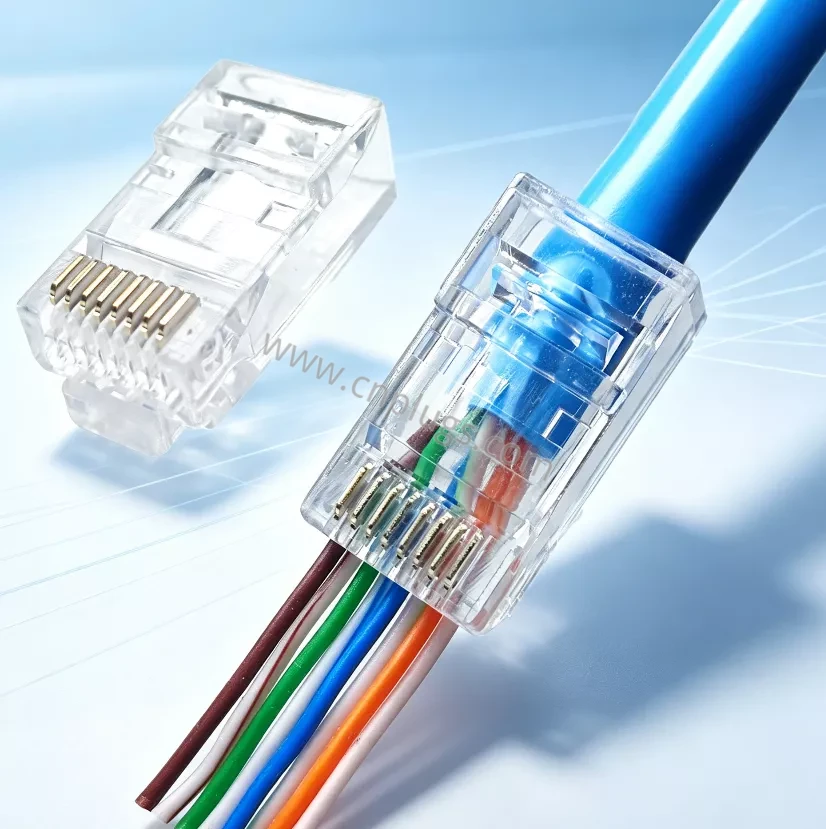
A pass-through RJ45 plug has openings at the front. After the wires are arranged, the conductors extend through the front of the connector. The installer can visually confirm that all eight wires are in the correct order before crimping.
A compatible pass-through crimp tool presses the contacts into the conductors and trims the excess wire at the plug face in the same operation. This design is often chosen for on-site installations, repair work, and projects where technicians need a fast way to inspect the pinout before final termination.
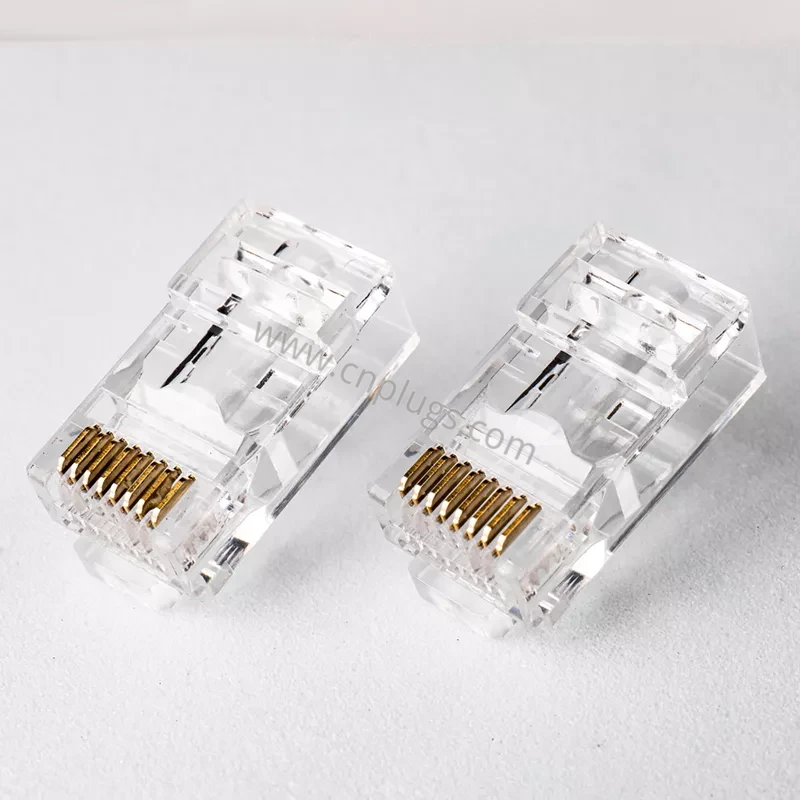
For example, PROUNTA’s EZ Pass-Through Cat6 RJ45 Unshielded Modular Plug is designed for Cat6 UTP solid and stranded conductors in the stated 23–24 AWG range. Its clear PC housing and pass-through structure help installers inspect the conductor order before crimping.
Pass-through vs. standard RJ45 plugs: key differences
| Feature | Pass-Through RJ45 Plug | Standard RJ45 Plug |
|---|---|---|
| Front of plug | Open; conductors extend through | Closed; conductors end inside housing |
| Wire-order check | Visible at the front before crimping | Checked before insertion and visually through housing where possible |
| Wire trimming | Usually trimmed by a compatible pass-through tool during crimping | Conductors are trimmed before insertion |
| Required tool | A crimp tool designed for the specific pass-through plug style | A conventional compatible RJ45 crimp tool |
| Typical advantage | Faster visual pinout verification | Familiar, established assembly process |
| Common applications | Field installation, repairs, installer kits, fast-turn projects | Patch-cord production, conventional installation, standard-tool workflows |
| Important consideration | Plug and tool must be compatible | Accurate conductor trimming and insertion are essential |
Why installers choose pass-through RJ45 plugs
1. The wire sequence is easier to verify
Incorrect wire order is one of the most common termination mistakes. With a pass-through connector, the conductors protrude from the front, making the T568A or T568B sequence easier to inspect before the final crimp.
This is especially helpful in on-site work, where lighting, access, time pressure, or repeated terminations can increase the chance of error.
2. Less pre-trimming is required
With a conventional closed-end plug, conductors need to be cut to a precise and even length before insertion. Pass-through plugs allow the wires to be fed through first. A compatible crimp tool then trims the ends as part of the termination process.
This may simplify the workflow for installers. Actual time savings depend on technician experience, cable type, tool condition, and the working environment.
3. They suit field installation and maintenance work
Pass-through designs are commonly used for LAN cabling, IP camera connections, Wi-Fi access-point installation, office moves and changes, and service repairs. For these jobs, the ability to quickly confirm the wire layout can be valuable.
4. Clear housings can improve inspection
High-clarity polycarbonate housings help technicians see conductor placement and contact alignment. Material quality also matters: a plug should have stable dimensions, appropriate mechanical strength, and a latch design suitable for its intended use.
Why standard RJ45 plugs remain a strong choice
Pass-through plugs are useful, but standard plugs are not outdated. They remain the preferred option for many buyers and production processes.
1. Conventional tools are widely available
Many installers and cable-assembly facilities already have standard crimp tools, work instructions, and quality-control processes in place. A standard plug fits naturally into that workflow.
2. They are familiar for high-volume assembly teams
Experienced assemblers can terminate conventional plugs efficiently. When a production line uses controlled cable lengths, consistent stripping and cutting fixtures, and established inspection procedures, a standard closed-end plug can be a practical choice.
3. No pass-through cutting edge is required
A pass-through plug should be used with a tool that is designed to trim the protruding conductors cleanly. Using an incompatible tool can leave uneven wire ends or affect termination quality. Standard plugs avoid this specific compatibility requirement.
How to choose the correct RJ45 plug
Do not select a connector by cable category alone. Before purchasing samples or placing a bulk order, check the following points.
Cable category and performance requirement
Match the plug to the cable system you are building. Cat5e, Cat6, Cat6A, and Cat8 applications can have different conductor sizes, performance targets, shielding needs, and connector designs.
For a typical unshielded Cat6 installation, a Cat6 UTP plug may be suitable. For high-noise environments, shielded cabling systems, or higher-performance applications, assess whether a shielded STP/FTP connector is required.
Solid or stranded conductor
Contact geometry is important. Some plug contact designs are optimized for solid conductors, stranded conductors, or both. A 3-prong contact design is commonly used where secure engagement with compatible solid and stranded conductors is required, but buyers should always confirm the supplier’s stated compatibility.
Conductor gauge and insulation diameter
Cable marked “Cat6” is not automatically the same physical size as every other Cat6 cable. Confirm:
- Bare conductor gauge, such as 23 AWG or 24 AWG
- Insulation outside diameter
- Overall cable outside diameter
- Solid or stranded construction
- Whether the cable uses a spline or separator
A plug that is too tight can be difficult to load. A plug that is too loose may not position the conductors correctly or provide reliable strain relief.
UTP or shielded construction
Use an unshielded plug for compatible UTP applications. For shielded cable systems or installations affected by electromagnetic interference, select a shielded connector and ensure the entire channel design—including cable, connector, jack, and grounding approach—supports the shielding requirement.
Tool compatibility
This is essential for pass-through connectors. Ask the supplier which crimp-tool style is compatible with the plug, request samples where possible, and test the complete termination process using the actual cable you plan to install or assemble.
Packaging and OEM requirements
For distributors and private-label brands, product performance is only one part of the decision. Confirm the packing format, quantity per bag or box, labeling, barcode requirements, carton marks, and inspection requirements before mass production.
PROUNTA offers standard 100-piece bag packaging for its Cat6 pass-through plug, with OEM packaging and labeling options available for qualifying orders. Contact our team to discuss samples, cable compatibility, and custom packing requirements.
Common applications
Pass-through RJ45 plugs are often selected for
- Office LAN installation and upgrades
- IP camera and security-system cabling
- Wi-Fi access points and PoE device connections
- Network maintenance and cable repairs
- Installer toolkits and contractor supply
- Small-batch custom Ethernet cable assembly
Standard RJ45 plugs are often selected for
- Conventional field termination workflows
- Patch-cord assembly operations
- Installers using existing standard crimp tools
- Cable-assembly processes with controlled trimming steps
- General Ethernet cabling where a pass-through design is not required
Best practices for reliable termination
Whether you choose a pass-through or standard plug, good installation practice is essential.
- Use the correct cable and connector combination. Check the plug’s stated AWG, conductor, and shielding compatibility.
- Keep pair untwist to a minimum. Excessive untwisting near the connector can affect transmission performance.
- Follow one pinout consistently. Use T568A or T568B according to the project standard; do not mix them unintentionally.
- Make sure the jacket enters the plug properly. The strain-relief area should clamp the cable jacket, not only the individual conductors.
- Use a properly maintained tool. A worn or incompatible crimper can cause incomplete contact engagement or poor trimming.
- Inspect every termination. Check conductor order, contact position, latch condition, and wire trimming.
- Test the completed link. Use a suitable tester for continuity and, where required, the applicable channel or permanent-link performance standard.
Frequently asked questions
Are pass-through RJ45 plugs faster than standard plugs?
They can simplify wire-order verification and remove the need to pre-trim conductors to the final insertion length. However, the practical result depends on the technician, the cable, the compatible tool, and the installation environment. Testing both styles with your actual workflow is the best way to decide.
Can I use a normal crimp tool with a pass-through plug?
Use a crimp tool specifically compatible with the pass-through plug design. The tool must both crimp the contacts correctly and trim the protruding conductors cleanly. Confirm compatibility with the plug supplier before purchase.
Do pass-through plugs work with solid and stranded cables?
Some designs are made for both, while others are not. Check the manufacturer’s specification for the specific plug. For example, the PROUNTA Cat6 pass-through UTP plug is specified for compatible solid and stranded Cat6 conductors in the 23–24 AWG range.
Should I choose UTP or shielded RJ45 plugs?
Choose based on the cable and complete system design. UTP plugs are appropriate for compatible unshielded cable. Shielded plugs are generally considered where a shielded cabling system or enhanced EMI control is needed.
Can RJ45 plugs be supplied with custom packaging?
Yes. B2B buyers can request options such as custom bag labels, barcodes, branded packaging, inner boxes, and export-carton markings. Discuss MOQ, artwork files, sampling, and lead time with the manufacturer before confirming an OEM order.
Final recommendation
A pass-through RJ45 plug is a practical choice for installers who value a visible wire-order check and a streamlined field-termination process. A standard RJ45 plug remains a dependable choice for established conventional workflows and teams using standard crimping tools.
The best connector is the one that fits your cable, tool, performance requirements, and installation process—not simply the one with the most features. Before a full purchase, request samples, terminate them with the actual cable and tool you will use, and test the completed assembly.
Need help selecting a Cat6 pass-through connector for your cable or private-label program? Explore the EZ Pass-Through Cat6 RJ45 Unshielded Modular Plug or send us your cable specification for a compatibility discussion.
 WeChat ID: