
An RJ45 plug may look like a small, standard component, but physical compatibility is critical to a reliable Ethernet termination. A connector that does not fit the conductor size, insulation diameter, cable construction, or shielding type can be difficult to assemble and may create inconsistent contact or strain relief.
For installers, cable assemblers, and distributors, one of the most important checks is wire gauge. This guide explains how to select a suitable RJ45 modular plug for 23 AWG, 24 AWG, and 26 AWG Ethernet cable—and which other specifications you should confirm before ordering samples or bulk quantities.
Quick answer
- 23 AWG cable is physically larger and is often used in solid-conductor Cat6 or Cat6A horizontal cabling. Choose a plug specifically rated for 23 AWG, and verify the insulation and overall cable diameter.
- 24 AWG cable is common in Cat5e and Cat6 installations. Many standard RJ45 plugs are designed around this range, but exact compatibility still varies by cable construction.
- 26 AWG cable is smaller and is commonly found in slim patch cables, flexible patch cords, and certain high-density applications. It needs a plug with contact geometry and conductor channels suitable for the smaller wire.
Do not select by AWG alone. Always confirm solid or stranded construction, conductor insulation diameter, cable outer diameter, plug style, and the manufacturer’s stated cable-compatibility range.
What does AWG mean in Ethernet cable?
AWG stands for American Wire Gauge, a sizing system used for wire conductors. In simple terms, a lower AWG number indicates a larger conductor diameter:
- 23 AWG is larger than 24 AWG
- 24 AWG is larger than 26 AWG
In network cabling, conductor size can affect electrical resistance, cable flexibility, PoE suitability, and how the cable fits inside an RJ45 connector. However, the bare conductor is only one dimension. The insulation around each conductor and the outer cable jacket also affect connector selection.
Why RJ45 plug compatibility matters
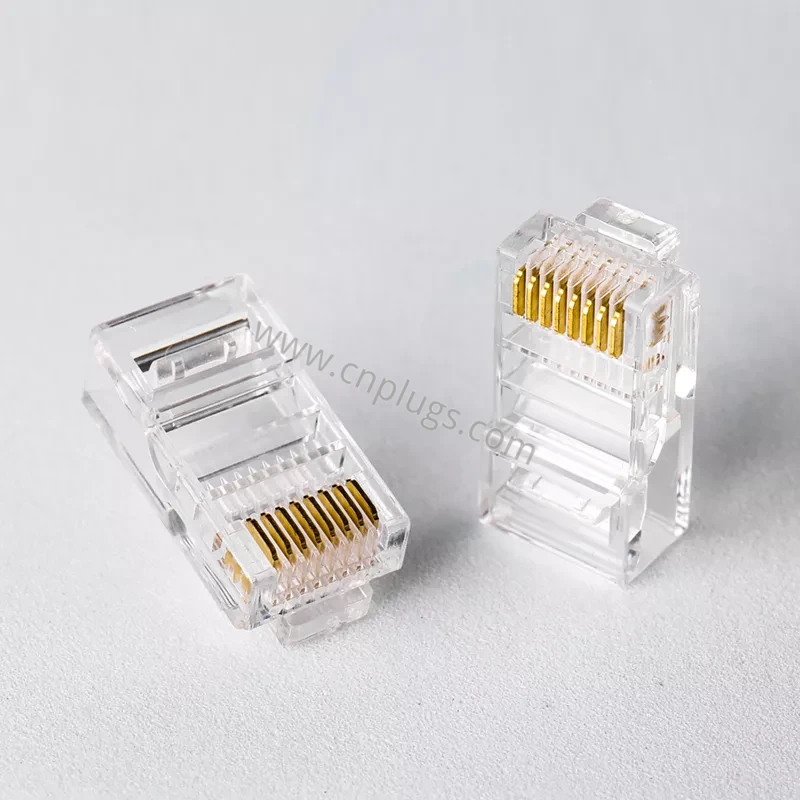
An RJ45 plug has eight conductor channels, contact blades, a cable-entry opening, and a strain-relief area. These elements must work together with the cable.
If the plug is too small for the cable, installers may experience:
- Difficulty feeding conductors into the channels
- Damaged or compressed insulation
- Incomplete conductor insertion
- Poor jacket strain relief
- Excessive force during crimping
If the plug is too large, potential issues include:
- Loose conductor positioning
- Inconsistent contact engagement
- Weak cable retention
- Greater risk of movement during installation
The objective is not simply to fit eight wires into the connector. It is to achieve consistent conductor alignment, secure contact engagement, appropriate strain relief, and a termination that can be tested against the required system performance.
23 AWG cable: what to check
Typical use
23 AWG cable is frequently used in solid-conductor Cat6 and Cat6A horizontal cabling. It is often chosen for permanent building links, offices, commercial networks, and PoE-capable installations where a robust conductor is preferred.
Because the conductors are relatively large, 23 AWG cable usually requires a plug with larger conductor channels and a cable-entry design that matches the overall cable diameter.
Buyer checklist for 23 AWG cable
When selecting a connector, verify:
- Stated conductor range: The product specification should explicitly include 23 AWG if this is your cable size.
- Solid or stranded wire: Most horizontal cable is solid conductor, but confirm the plug contact design supports it.
- Insulated conductor diameter: Two 23 AWG cables can have different insulation thicknesses.
- Overall cable diameter: A spline, thicker jacket, or shield layer can make the cable significantly larger.
- Shielding requirement: For F/UTP, S/FTP, or other shielded systems, choose an appropriate shielded plug and grounding arrangement.
- Tool compatibility: Confirm the crimp tool works with the selected plug style.
For compatible Cat6 UTP solid or stranded cable in the 23–24 AWG range, see PROUNTA’s EZ Pass-Through Cat6 RJ45 Unshielded Modular Plug. Buyers should still test samples with their actual cable before confirming a production order.
24 AWG cable: what to check
Typical use
24 AWG is widely used in Cat5e and Cat6 Ethernet cabling. It is found in both solid horizontal cable and stranded patch-cord cable, making it one of the most common ranges for RJ45 plug selection.
Although 24 AWG is common, “24 AWG compatible” is not enough information for a purchasing decision. A stranded 24 AWG patch cable and a solid 24 AWG installation cable can have different conductor behavior and different insulation dimensions.
Buyer checklist for 24 AWG cable
- Confirm whether the conductors are solid or stranded.
- Check that the contact blade style is suitable for that conductor construction.
- Measure or obtain the insulated conductor diameter from the cable specification.
- Confirm the plug accepts the finished cable’s outside diameter.
- For pass-through connectors, confirm that the compatible crimp tool trims the protruding conductors cleanly.
- Test completed assemblies with the cable tester appropriate to the project.
26 AWG cable: what to check
Typical use
26 AWG cable is often used where flexibility, smaller cable diameter, or higher cable density is desired. Common examples include slim patch cords, equipment-room patching, short network leads, and certain pre-assembled cable products.
The smaller conductor requires particular care. A connector designed only for larger 23–24 AWG conductors may not hold or position 26 AWG conductors correctly.
Buyer checklist for 26 AWG cable
- Confirm the lower end of the plug’s stated AWG range. Do not assume a Cat6 plug designed for 23–24 AWG will also support 26 AWG.
- Check stranded-wire compatibility. Many 26 AWG patch cords use stranded conductors for flexibility.
- Assess contact design. The contact blades need to engage the smaller conductor reliably without damaging it.
- Check strain relief. A slim cable may need a plug designed to grip a smaller jacket securely.
- Request a sample test. Test pull resistance, continuity, and link performance with the real cable and tool.
AWG is not the only specification that matters
1. Solid vs. stranded conductors
Solid conductors are commonly used for permanent horizontal cabling. Stranded conductors are common in flexible patch cords. Connector contacts are designed to pierce insulation and make electrical contact with the conductor, so the contact geometry must suit the cable type.
Some RJ45 plug designs are specified for both solid and stranded cable. Others are optimized for one construction. Always use the supplier’s documented compatibility range.
2. Insulated conductor diameter
The bare copper size may be the same, but insulation thickness can vary between cable brands and constructions. This changes how the eight conductors fit into the plug channels.
For a new cable supplier or cable design, request the cable datasheet and measure a physical sample if possible.
3. Overall cable outside diameter
The plug boot area and strain-relief section must match the cable jacket. This is especially important for:
- Cat6A cable with larger outside diameter
- Shielded cable with foil, braid, or drain wire
- Outdoor and industrial cable with heavy jackets
- Cables using internal splines or separators
4. UTP vs. shielded cable
UTP plugs are intended for compatible unshielded cable. For shielded cabling, the connector needs a suitable metal shell or shield structure, and the entire channel design should support the intended grounding and EMI-control approach.
Choosing a shielded plug does not automatically make a system shielded; correct cable, jack, panel, grounding, and installation practices also matter.
5. Pass-through vs. standard plug style
A pass-through RJ45 plug lets conductors extend through the plug face for visual pinout verification before crimping. A standard plug has a closed front and requires the conductors to be trimmed to length before insertion.
Neither style is universally better. The choice depends on your installation workflow, tool availability, operator preference, and plug/cable compatibility. Read our related guide: Pass-Through vs. Standard RJ45 Plugs: Which Connector Should You Choose?
Comparison: 23 AWG vs. 24 AWG vs. 26 AWG cable
| Cable Size | Relative Conductor Size | Common Uses | Key Connector Consideration |
|---|---|---|---|
| 23 AWG | Larger | Cat6/Cat6A horizontal cabling, commercial installations, PoE-capable links | Use a plug explicitly rated for 23 AWG; check larger insulation and cable OD |
| 24 AWG | Medium | Cat5e/Cat6 horizontal cable and general Ethernet applications | Confirm solid vs. stranded construction and actual insulation diameter |
| 26 AWG | Smaller | Slim patch cords, flexible leads, high-density patching | Use a plug designed for smaller conductors and suitable strain relief |
A practical sample-testing process for B2B buyers
Before ordering a large quantity of RJ45 plugs, use a defined sample-validation process.
Step 1: Share complete cable information
Provide the connector supplier with:
- Cable category: Cat5e, Cat6, Cat6A, or other
- Conductor gauge: 23 AWG, 24 AWG, 26 AWG, etc.
- Solid or stranded conductor construction
- Insulated conductor diameter, if available
- Overall cable outer diameter
- UTP or shielded construction
- Intended application: patch cord, field termination, PoE, industrial use, and so on
Step 2: Request matched samples
Request samples of the proposed plug, and if applicable, the recommended boot and compatible crimp tool. For OEM projects, confirm the standard product first before moving to packaging or logo customization.
Step 3: Terminate with the actual cable
Use the same cable brand and construction planned for production or installation. Follow the appropriate T568A or T568B pinout and use a properly maintained crimp tool.
Step 4: Inspect the result
Check:
- All eight conductors are in the correct order
- Each conductor reaches the intended contact position
- Contact blades are seated consistently
- The cable jacket is captured by the strain relief
- The latch and plug body are undamaged
- Pass-through wire ends, if used, are trimmed cleanly
Step 5: Test the cable assembly
Perform the test appropriate to your requirement. This may include basic continuity and wire-map testing, or more complete link-performance testing for structured-cabling projects.
Frequently asked questions
Can I use one RJ45 plug for 23 AWG, 24 AWG, and 26 AWG cable?
Only if the manufacturer explicitly states that the plug supports the complete range and the cable’s insulation and outside-diameter dimensions also fit. Many plugs are designed for a narrower range, so do not assume broad compatibility.
Is 23 AWG always better than 24 AWG or 26 AWG?
Not necessarily. Cable selection depends on system category, installation type, flexibility needs, PoE requirements, cable length, and the applicable project standard. Larger conductors can offer lower resistance, while smaller conductors may be useful for flexible or high-density patching. Select the cable and connector as a matched system.
Can a 23–24 AWG Cat6 plug be used with 26 AWG patch cable?
Do not assume so. A 26 AWG cable may be too small for the conductor channels or strain-relief design of a connector made for larger conductors. Use a plug that is specifically rated for the 26 AWG cable construction.
Why does my cable fit into the plug but fail after crimping?
Possible causes include incorrect contact design for the conductor type, unsuitable conductor or insulation diameter, incomplete insertion, poor strain relief, a worn tool, or an incompatible plug/tool combination. Check the complete system rather than only the cable-entry fit.
Should I test samples before a wholesale order?
Yes. Sample testing with the actual cable, tool, and intended installation process is the most reliable way to verify connector compatibility before purchasing in bulk.
Final recommendation
The right RJ45 plug is selected by matching wire gauge, conductor construction, insulation diameter, cable outside diameter, shielding, and termination tool. AWG provides an important starting point, but it is not a complete compatibility specification.
For Cat6 UTP cable in the stated 23–24 AWG range, a pass-through plug can provide an efficient way to verify conductor order during field termination. For smaller 26 AWG patch cable, select a connector specifically designed and tested for that cable construction.
If you are sourcing RJ45 plugs for a project, distribution program, or private-label range, contact PROUNTA with your cable specification to discuss samples, compatibility, packaging, and bulk-order requirements.
 WeChat ID: