
Cat6A Shielded Pass Through RJ45 Connector: 10Gbps STP/FTP 8P8C Modular Plug for Cat6A and Cat7 S/FTP Cable
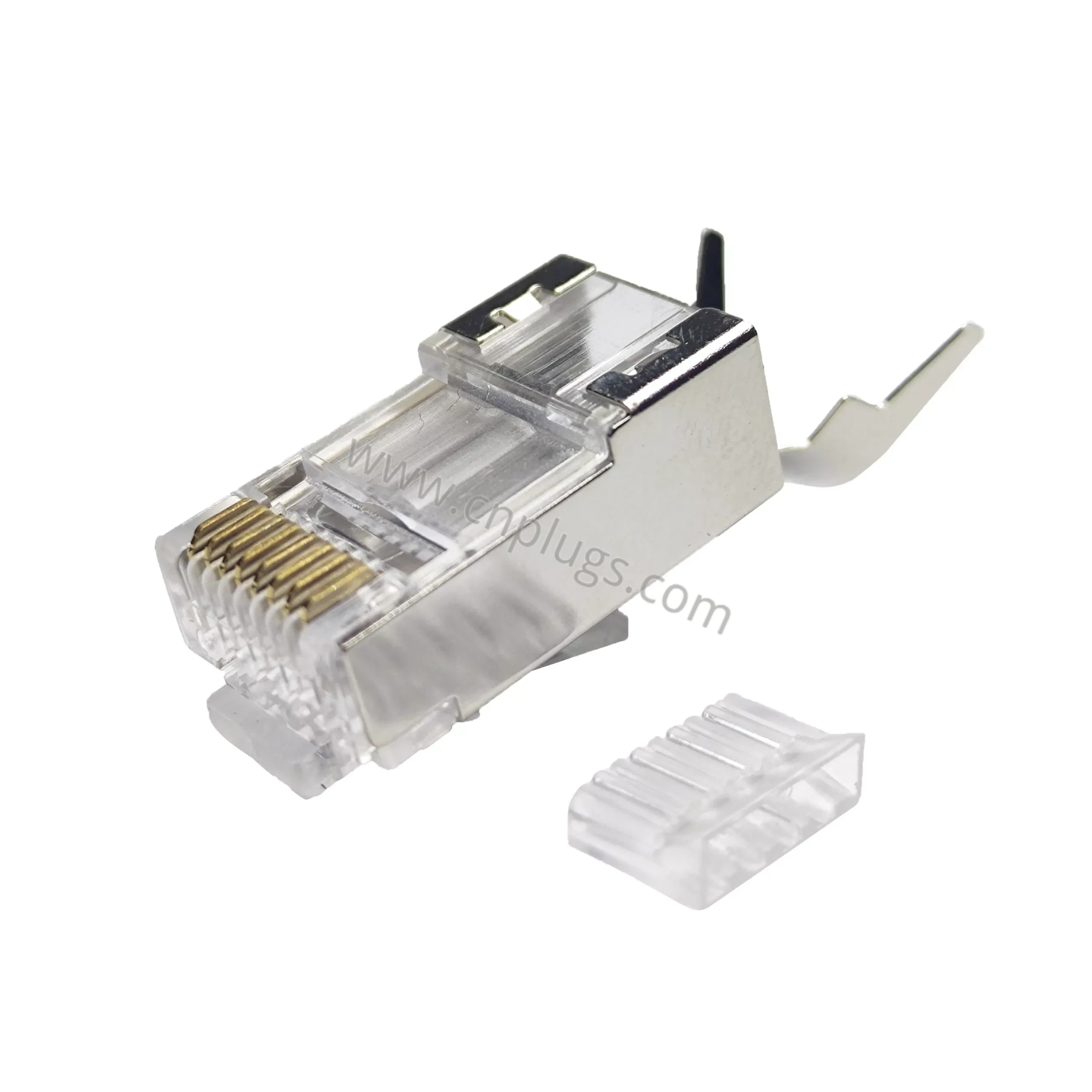
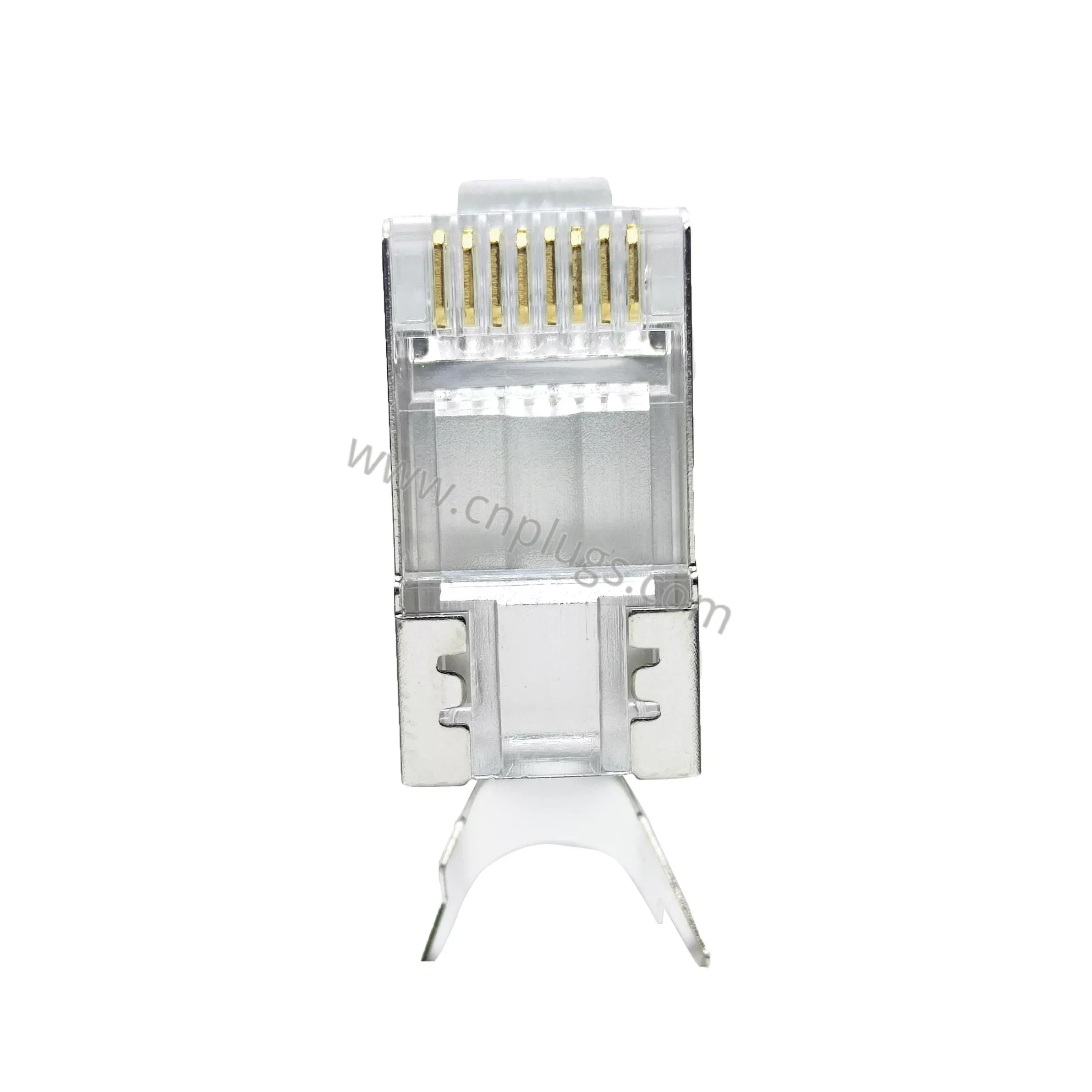
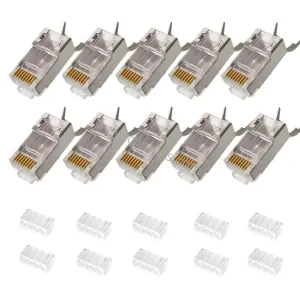
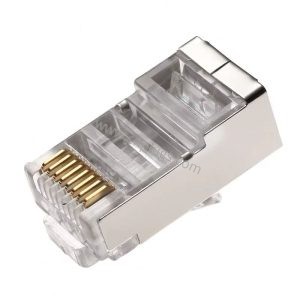
The Prounta Cat6A shielded pass through RJ45 connector is a die-cast zinc alloy 8P8C modular plug built for 10-gigabit shielded cabling — Cat6A, Cat7 and Cat7A S/FTP. It combines three things that matter once you leave Cat5e behind: a full 360° metal shell that maintains shield continuity into the jack, a pass-through nose that lets the technician verify wire order before crimping, and a large bore that accepts the heavy conductors and thick jackets of genuine S/FTP cable. It is rated and tested to ANSI/TIA-568.2-D Cat6A and ISO/IEC 11801 Class EA: 10 Gbps at 500 MHz over 100 metres. Below we also answer, plainly, the question every buyer of this part eventually asks — whether an RJ45 plug can be called Cat7.
Can You Use an RJ45 Connector on Cat7 Cable? The Honest Answer
Yes, you can, and most of the industry does — but the terminology deserves precision, because it affects certification reports and procurement submittals. Cat7 is not recognised by ANSI/TIA; the TIA category progression runs Cat5e, Cat6, Cat6A, then Cat8, skipping 7 entirely. Cat7 exists as Class F under ISO/IEC 11801, and that specification nominates the GG45 and TERA connectors rather than 8P8C, because the original 600 MHz Class F requirement was written around connector geometry the standard RJ45 was not designed to meet. In practice GG45 and TERA are expensive, bulky and thinly stocked, so the overwhelming majority of Cat7 cable installed worldwide is terminated with shielded RJ45 plugs like this one. That works because Cat7 cable uses the same eight-position pin assignment as every other twisted-pair category, and a properly bonded metal shell preserves the cable’s shielding performance. What you should understand — and what we would rather tell you than let a Fluke report tell you — is that the finished channel certifies as Cat6A / Class EA, not Class F, because the connector becomes the limiting element. For virtually every real network that is irrelevant: 10GBASE-T over 100 metres is a Cat6A specification, and this plug delivers it. If your project genuinely requires certified Class F, you need GG45 or TERA hardware and this is not the part. If your project requires 10 Gbps on shielded cable that happens to be labelled Cat7, this is exactly the part. For lower-frequency shielded work, see our Cat6A STP/FTP shielded modular plug.
Why Cat6A Termination Is Less Forgiving Than Cat6
At 500 MHz the connector stops being a passive piece of plastic and becomes part of the transmission line. Three failure modes appear that Cat5e installers rarely meet. Alien crosstalk — coupling between adjacent cables rather than between pairs inside one cable — is the parameter Cat6A was specifically created to control, and it is where a poorly shielded plug ruins an otherwise good channel; the metal shell and its bonding path are what suppress it. Untwist length matters far more: every millimetre of pair separation at the termination degrades return loss and NEXT margin, so conductors must be kept twisted as close to the contacts as the design allows. And the physical cable is simply harder to handle — genuine S/FTP has individually foiled pairs plus an overall braid, a stiff jacket and 22–23 AWG conductors, which is why plugs sized for Cat5e will not close on it. This connector is dimensioned for that reality, with a 1.45 mm conductor bore and 8.0 mm jacket capacity. Background on the physics is at crosstalk.
Shield Continuity, Grounding and the Zinc Alloy Shell
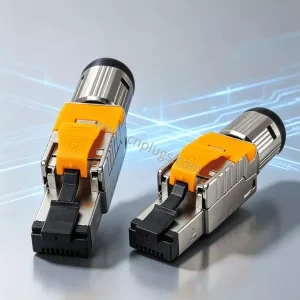
The shell is die-cast zinc alloy rather than folded sheet metal, giving a rigid, fully enclosed body with no seam gaps for high-frequency energy to escape through, and it is nickel-plated for corrosion resistance and low contact impedance. At the rear, crimp wings clamp the braid, foil and drain wire mechanically against the shell interior so the bond is gas-tight rather than incidental. On insertion the shell mates with the spring fingers of a shielded jack or patch panel, carrying the shield onward to the panel frame and the rack earth bar. Two rules govern the result. First, bond at both ends through the connector shells, referenced to the same building ground via equipment chassis; improvised ground pigtails are the usual cause of the loops people wrongly blame on double-ended bonding. Second, the component rule is absolute — an unshielded plug on shielded cable breaks continuity and can leave the foil acting as an unterminated antenna, which is why a badly terminated shielded run often performs worse than plain UTP. If the drum says S/FTP, F/UTP or STP, every component in the channel must be shielded. Where field termination without a crimper suits the job better, use our Cat6A toolless zinc alloy shielded field-termination plug.
Technical Specifications
| Parameter | Specification |
|---|---|
| Model No. | PR-C6ASP-Z1 (Cat6A shielded pass-through, zinc alloy) |
| Rated Category | Cat6A — ANSI/TIA-568.2-D, ISO/IEC 11801 Class EA |
| Cable Compatibility | Cat6A, Cat7, Cat7A S/FTP · F/UTP · U/FTP · STP (solid & stranded) |
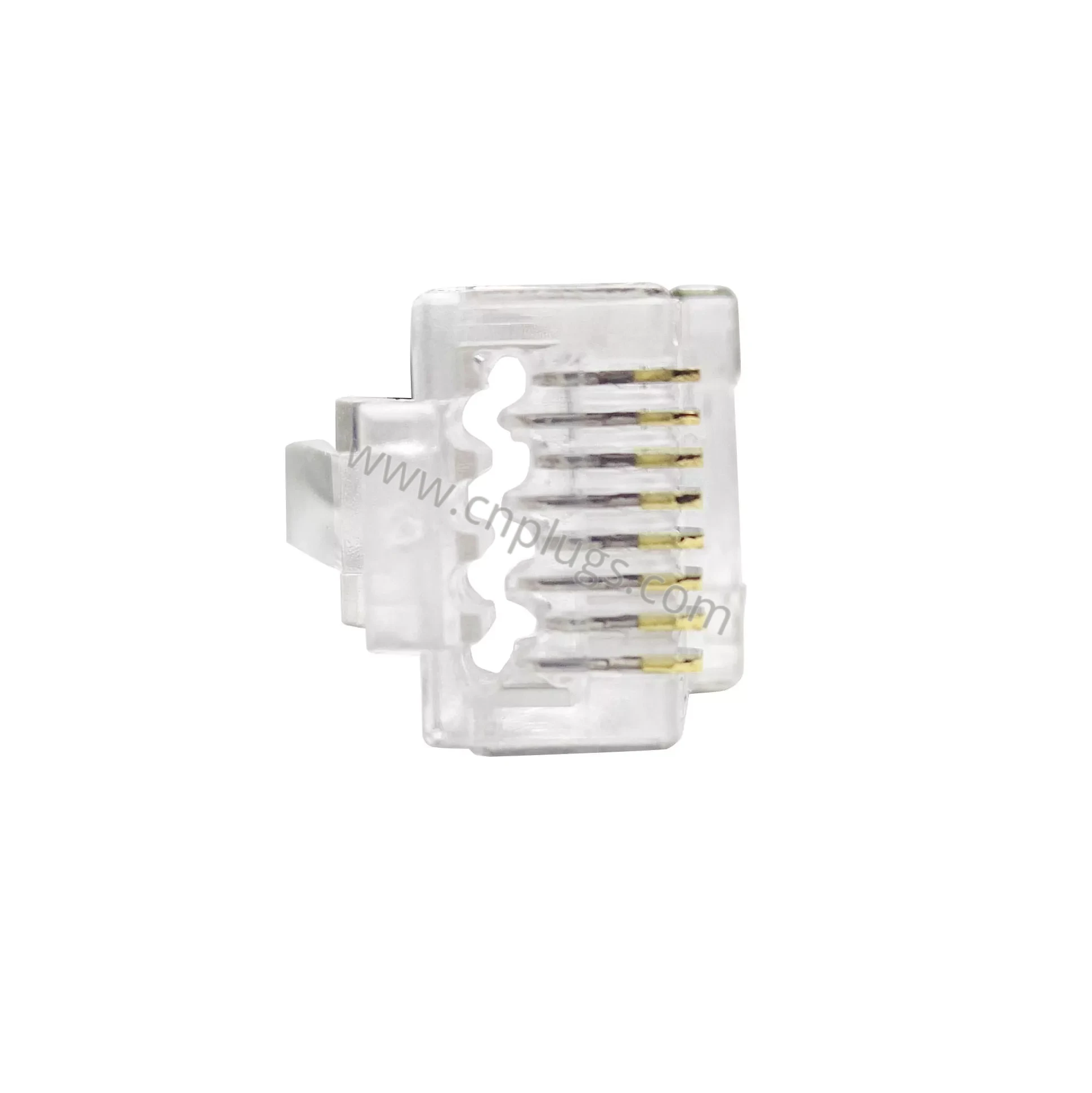
| Configuration | 8 Position 8 Contact (8P8C), pass-through / feed-through |
| Bandwidth | 500 MHz |
| Data Rate | 10GBASE-T, 10 Gbps to 100 m |
| Shell Material | Die-cast zinc alloy, nickel-plated, 360° coverage |
| Shield Termination | Rear crimp wings onto braid + foil + drain wire; shell-to-jack spring contact |
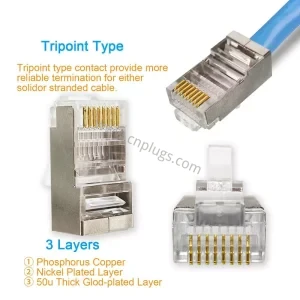
| Contact Material | Pure copper alloy / phosphor bronze |
| Contact Plating | 50µ” gold over nickel (30µ” / 15µ” optional) |
| Insert Material | 100% virgin polycarbonate, UL 94V-0 |
| Conductor Size | 22–26 AWG, solid and stranded |
| Conductor Insulation OD | 1.10 – 1.45 mm |
| Cable Jacket OD | Up to 8.0 mm |
| Required Tool | Pass-through crimper with integrated flush-cut blade (mandatory) |
| Current Rating | 1.5 A per contact (PoE / PoE+ / PoE++ 802.3bt, 90 W) |
| Voltage Rating | 150 V AC (rms) |
| Contact Resistance | ≤ 20 mΩ |
| Shell-to-Shell Resistance | ≤ 50 mΩ |
| Insulation Resistance | ≥ 500 MΩ @ 500 V DC |
| Dielectric Strength | 1000 V AC / 1 minute, no breakdown |
| Durability | ≥ 750 mating cycles |
| Salt Spray | 48 hours, no visible corrosion |
| Operating Temperature | -40 °C to +85 °C |
| Compliance | RoHS, REACH, ISO 9001, UL-recognised material |
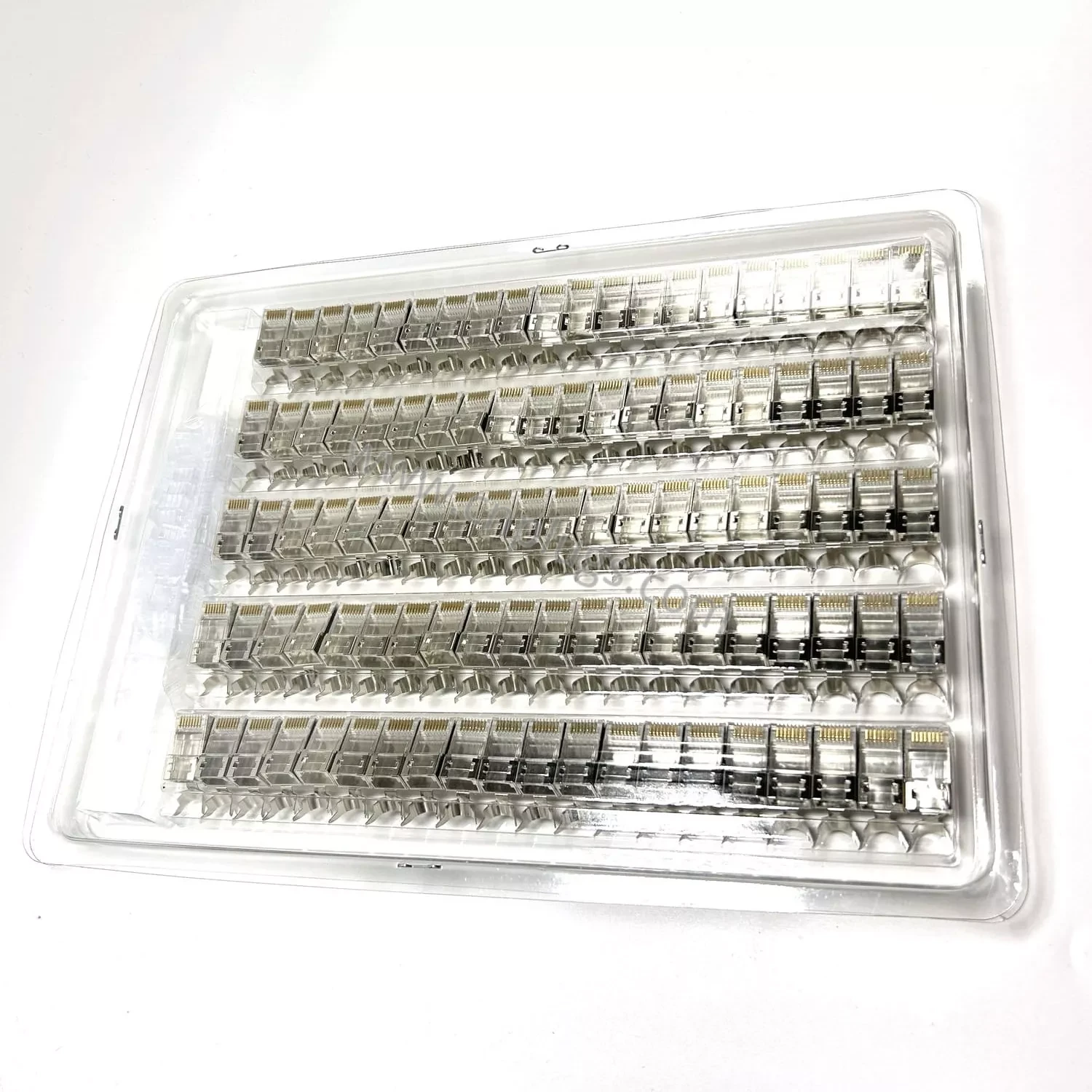
| Packaging | 50/100 pcs bag or jar, blister card, OEM carton |
| MOQ / Lead Time | Stock from 1,000 pcs; custom logo from 10,000 pcs; 7–15 days |
Termination Procedure and the Flush-Trim Rule
A pass-through plug requires a pass-through crimper with an integrated flush-cut blade. This is not a preference. A standard crimper leaves protruding conductors that stop the plug seating in the jack and, in a shielded jack, can reach the metal frame. Strip the jacket, fold the braid back over it, dress the foiled pairs, keep the twist as tight to the nose as possible, feed the conductors through in T568A or T568B order, confirm the sequence visually, seat the jacket under the crimp wings, then crimp with a sharp blade. On shielded work, apply the technique experienced installers use: after the flush cut, ease the cable back roughly half a millimetre so the copper ends retract inside the nose profile, then complete the crimp. Replace blades on schedule — a dull blade is the root cause of most poor terminations. One reassurance on corrosion: the IDC prongs pierce the conductor behind the cut end, so the signal path never crosses the exposed tip. Every batch we ship is verified on Fluke DSX-8000 equipment before it leaves the plant.
Custom Logo, Private Label and Factory-Direct Supply
Stamping, zinc die-casting, plating, moulding, assembly and testing all take place in our own plant, and this connector is sold to you directly rather than through an exporter. Pricing comes off production cost; engineering requests such as a different bore, shell finish, plating thickness or nose profile are answered by the people who own the tooling and become drawings rather than refusals; and each batch ships with its own Fluke test report so non-conformities are corrected at source. Volume buyers are welcome to audit the line. Private-label options include laser-marked and mold-engraved logos, custom shell finishes and complete retail packaging carrying your barcode and SKU, all approved from artwork and 3D renderings before tooling is cut. See comparable work on our pure copper connector free-sample programme and browse the full Cat6A and Cat8 plug range.
Frequently Asked Questions
Is this a Cat7 connector? It is a Cat6A-rated connector that terminates Cat7 and Cat7A cable. No 8P8C plug can be certified Cat7, because ISO/IEC 11801 Class F specifies GG45 or TERA connectors and TIA does not recognise Cat7 at all. Any supplier selling a “certified Cat7 RJ45” is misusing the term. On Cat7 cable this plug delivers a Cat6A / Class EA channel — 10 Gbps over 100 m — which is what nearly every project actually requires.
Then why is my cable labelled Cat7? Cat7 S/FTP is a real ISO construction with individually foiled pairs and an overall braid, and it is widely sold. It is excellent cable. The limitation is at the connector, not in the cable, and terminating it with a quality shielded RJ45 is standard industry practice.
Cat6A or Cat7 — which should I specify for new work? Cat6A. It reaches 10 Gbps over 100 m, is TIA-recognised, certifies cleanly on standard testers, and uses universally available RJ45 hardware. Most North American specifications reference TIA categories, so Cat7 can complicate submittals for no measurable gain.
Do I need a special crimping tool? Yes — a pass-through crimper with a flush-cut blade. A standard crimper will not trim the conductors and the plug will not seat correctly.
Will the protruding wires short against a shielded jack? Not when terminated as specified: flush-cut, retract the cable about half a millimetre, then crimp. The nose is profiled to keep trimmed copper clear of the mating face.
Does this fit Cat8 cable? It accepts jackets to 8.0 mm and conductors to 1.45 mm, which covers many Cat8 constructions mechanically, but Cat8 channels require Cat8-rated components to certify at 2000 MHz. Ask us for the correct part.
Is it compatible with standard RJ45 jacks? Yes — full backward compatibility with Cat6A, Cat6 and Cat5e shielded jacks, switches and patch panels. Unlike GG45 and TERA, nothing about your existing infrastructure needs to change.
Do you provide free samples? Yes. Verified business buyers receive a free sample kit and pay courier cost only, credited against the first order. Contact our engineering team for samples, drawings, factory audits or bulk pricing, or browse the full RJ45 connector catalogue.
 WeChat ID: