
Most of the world’s RJ45 modular plugs are made in southern China. For buyers that concentration cuts both ways. It brings competitive pricing and a mature supply chain, but it also means B2B marketplaces mix real factories with trading companies, and quality differences between factories are large. A plug that looks identical in photos can differ in contact blade geometry, gold plating thickness and housing material, and those differences only show up after you have placed an order.
This guide walks through the process importers, brand owners and cabling distributors actually use: building a shortlist, separating manufacturers from middlemen, verifying certificates, testing samples, and structuring a first order so quality requirements are defined before money changes hands.
A note on sources. This article is published by PROUNTA, an RJ45 plug factory in Dongguan. The checklist applies to any supplier, including us. Where we reference our own capability, links point to our factory tour and testing pages so you can check the claims yourself.
Where RJ45 Connectors Are Actually Made
RJ45 plug manufacturing clusters in the Pearl River Delta, mainly Dongguan and Shenzhen, with additional capacity in Zhejiang’s cable and connector belt. The clustering matters for two reasons.
First, the supporting chain is local: polycarbonate resin, copper alloy strip, gold plating chemistry, precision mold bases and automated assembly equipment are all sourced within a few hours’ drive. That shortens development loops and keeps tooling costs below what buyers in most other regions would pay.
Second, cluster location says nothing about quality by itself. Two factories in the same industrial park can have completely different process control. Location is a filter for capability and price level. It is not a quality signal. Never treat “made in Dongguan” as a shortcut for due diligence.
Step 1: Manufacturer or Trading Company? Decide Which One You Need
Both exist on every platform, and both have a role.
| Aspect | Manufacturer | Trading Company |
|---|---|---|
| Price on large volume | Usually better | Margin added |
| Engineering questions (cable fit, blade design, plating) | Answered by the people who make it | Relayed, often slowly or wrongly |
| OEM: your logo on plugs and packaging | Direct control | Depends on the factory behind them |
| Tooling for custom parts | Owned in-house | You may not know who owns the mold |
| Small mixed orders | Often refused | Flexible, many SKUs in one carton |
| Quality disputes | Direct correction loop | Extra layer between you and the cause |
If you plan private-label products, custom gold plating, or volumes beyond a few cartons, work with a factory directly. If you need ten different SKUs in small quantities for a retail assortment, a capable trader can save real work.
How to tell them apart before you spend anything:
- Check the business license scope. Chinese business licenses list permitted activities. Manufacturing and production wording indicates a factory. Wholesale, retail and trading wording indicates a trader. You can ask for a scan early; legitimate suppliers share it.
- Ask for a live video walkthrough, not a recorded promo. Request specific shots: contact stamping presses, injection molding machines, pin insertion lines, QC lab. A trader can send polished video, but cannot walk a camera through their own production floor on a live call.
- Ask one engineering question and watch who answers. Example: “Our cable jacket OD is 6.1 mm with 23 AWG solid conductors. Which of your Cat6 plugs fits it?” A factory answers with data. A trader says “let me confirm” and comes back days later.
- Ask about mold development. Factories doing OEM work will describe their mold workshop and tolerances. Traders rarely know the details.
For reference, our own facility covers precision mold design, high-speed contact stamping, injection molding, automatic pin insertion and optical inspection under one roof, which you can inspect on the factory tour page.
Step 2: Certificates and Documents to Request
Shortlist only suppliers who can send these documents as PDFs within a day or two. Slow or reluctant document handling is an early warning sign.
| Document | What It Tells You |
|---|---|
| ISO 9001 certificate | A quality management system exists; verify the certificate number with the issuing body |
| RoHS certificate | Restricted substances controlled for the EU market (Directive 2011/65/EU) |
| REACH statement | SVHC compliance declarations for EU import |
| CE certificates / test reports | Required documentation set for EU sales; check which directives the report covers |
| UL 94 rating for the housing | Flammability class of the polycarbonate, typically V-0 or V-2 for plugs |
| Dimensional compliance | Plugs built to ANSI/TIA-1096-A (the successor of FCC Part 68) and the IEC 60603-7 series mate correctly with standard jacks |
| Category performance reports | For Cat6/Cat6A/Cat8 claims, channel or permanent link test data per ISO/IEC 11801 or ANSI/TIA-568.2-D |
Two practical checks. First, every certificate has a number and an issuing body; spot-check at least one. Second, notice whether the documents are organized and current. A factory that exports regularly keeps them ready. Ours are published openly on the certifications and compliance page, including CE certificates and test reports for Cat6 and Cat7 plug families.
Standards context for the RJ family: the registered jack system traces back to the US Bell System and was regulated under FCC Part 68; today the physical specifications for modular connectors are maintained as ANSI/TIA-1096-A in the US and IEC 60603-7 internationally. If a supplier has never heard of these documents, stop there.
Step 3: Read Their Equipment List
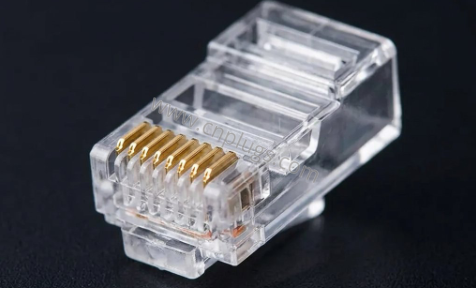
Plug quality is decided in three processes: contact blade stamping, gold plating, and housing injection. Everything downstream is verification. Ask what the factory runs in-house.
The baseline for a serious RJ45 factory:
- High-speed precision stamping presses for contact blades
- Plastic injection molding for housings
- Automatic pin contact insertion machines
- Automated optical inspection (AOI/CCD) on finished plugs
- Plating capability in-house or with a stable, named subcontractor
- A lab with at least: a cable/channel analyzer for performance claims, an X-ray fluorescence (XRF) gauge for plating thickness, a salt spray chamber, and insertion/withdrawal testers
A factory without optical inspection is sorting defects by hand or not sorting at all. A factory without any plating measurement is quoting gold thickness from hope. If you want a concrete example of how an equipment list maps to quality claims, the PROUNTA testing equipment page shows our Fluke DSX-8000 setup, XRF gauging, salt spray chamber and the four-stage IQC/IPQC/FQC/OQC workflow.
Step 4: Verify Samples Before You Order
Never place a first order on photos and promises. Request samples of the exact SKUs you intend to buy, then run a short verification sequence.
| Check | Method | Reference |
|---|---|---|
| Dimensions and mating | Mate with known-good jacks; check latch feel, retention and full seating | ANSI/TIA-1096-A, IEC 60603-7 series |
| Gold plating thickness | XRF measurement on sample contacts; request the reading, not just a claim | Commercial tiers run flash, 3, 6, 15, 30 and 50 µin over nickel |
| Cable fit | Terminate the plug on your actual cable: jacket OD, AWG, solid or stranded, shielded or UTP | Category printed on the bag is a performance target, not a fit guarantee |
| Electrical performance | Continuity on every sample; channel or permanent link testing on an analyzer for Cat6A/Cat8 claims | ISO/IEC 11801, ANSI/TIA-568.2-D |
| PoE suitability | Resistance unbalance check if the plugs will carry 4PPoE | IEEE 802.3bt |
| Durability | Mating cycle specification; latch bending behavior | IEC 60603-7 series durability requirements; common specs are 750+ cycles |
| Corrosion | Salt spray test report for the plating system | ASTM B117 |
The plating item deserves extra attention because it is the easiest to fake. “50 micro-inch gold” costs real money, and thin or flash plating passes a visual check but fails after months in humid or high-mating environments. Our gold plating guide explains what each thickness tier is actually good for, and the field testing article shows which measurements matter once plugs are installed. If you are buying in volume for resale, also screen for copper-clad aluminum conductors in any patch cord samples, using the method in our CCA detection guide.
If your sample results are weak, share the data with the supplier and watch the reaction. A factory will adjust the process and resend. A middleman will argue about the price.
Step 5: Audit Without Boarding a Plane
You do not need to fly to China for a first order, but you do need eyes on the operation.
- Live video audit. Two hours on a call walking raw material storage, stamping, injection, assembly, QC lab and packing. Prepare a shot list in advance so the call cannot dodge the boring areas.
- Document audit. ISO certificate, calibration records for test equipment, raw material certificates for PC resin and copper alloy, RoHS/REACH reports. Ask which records are kept and for how long.
- Reference check. Ask for two or three export customers in your region and actually contact them. Customs data services can also show a company’s shipment history, which is harder to fabricate than a reference letter.
- Third-party inspection for the first shipment. Book a pre-shipment inspection with SGS, Intertek, Bureau Veritas or a regional equivalent. Inspection follows ISO 2859-1 sampling plans: General Inspection Level II is the default, and the AQL you set depends on how you classify defects. Buyers of connectors commonly work around AQL 0.65 to 2.5 across critical, major and minor classes, written into the purchase contract.
Step 6: Red Flags That Save You Money
| Red Flag | Why It Matters |
|---|---|
| Cannot state plating thickness with a number | The cheapest and most faked spec on the product |
| Refuses live video or a shot list | Nothing to show, or not the real producer |
| Certificates without numbers or issuing bodies | Often fabricated or borrowed from another company |
| “Cat6A” claim with no channel test report | Category labels are marketing until tested |
| Price far below the market given copper and gold costs | Material substitution is the only way to hit that number |
| Perfect samples but no production data | Hand-built samples do not represent mass production |
| No deviation or complaint process | Problems are guaranteed; process is what you are buying |
| Vague answers about mold ownership | Blocks any future OEM work and disputes |
Step 7: Structure the First Order
Treat the first purchase as a paid audit, not as supply.
- Start with a pilot batch sized for your own QC, customer samples and one real installation, not a full container.
- Write the quality agreement before payment: AQL levels by defect class, packaging specification, labeling and barcode requirements, replacement terms for failed lots.
- Book pre-shipment inspection and make payment terms release after the inspection report passes.
- Keep a sealed sample lot from the batch for future disputes.
- Ramp in steps. Second order at 2 to 3 times the pilot, third order at production volume, each with the same inspection gate.
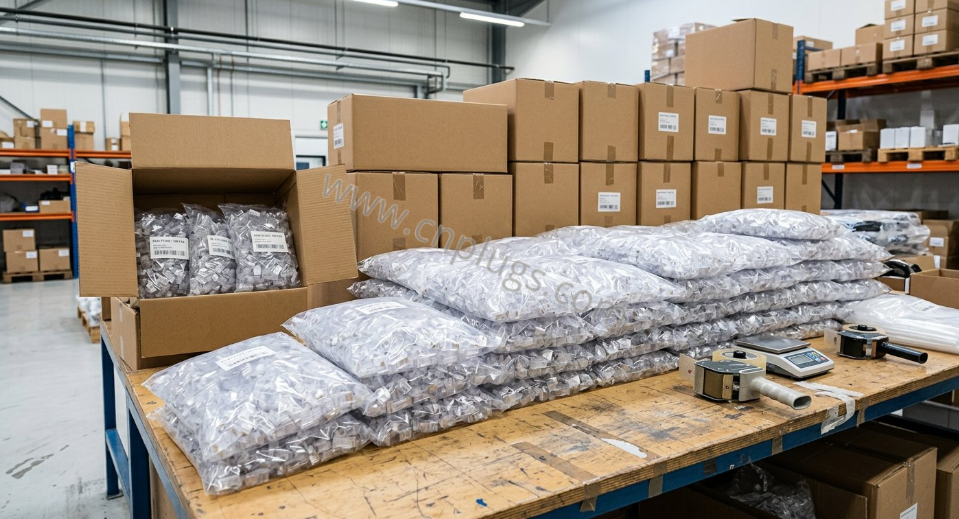
If your volumes are already meaningful, read our companion guide on choosing bulk RJ45 connectors for a production line before you set the pilot spec, and use the complete RJ45 modular plug technical guide for the supplier evaluation framework behind the checklist above. If you are sourcing for a brand rather than for installation, the OEM/ODM overview explains what customization options typically exist.
The Short Version
Build a shortlist from real factories, not platform rankings. Verify certificates by number. Demand a live video audit and engineering-level answers about cable fit. Test samples for plating, dimensions and channel performance. Inspect the first shipment to ISO 2859-1. Every step above costs a few days. A bad container costs months.
If you want to run this checklist against us, start with the factory tour, the testing standards page and the published certificates. Request samples and we will answer the engineering questions directly.
FAQ
What is the typical MOQ of an RJ45 connector factory in China?
It depends on the SKU. Standard plugs in stock packaging are usually sold by bag or box quantities, while custom work (your logo on the housing, custom plating, special packaging) carries higher minimums because it consumes machine setup and tooling time. Ask for a written MOQ list per product line before you compare prices.
How do I verify a “50 micro-inch gold plating” claim?
Ask for an X-ray fluorescence (XRF) reading on the actual contact area, not the housing. If you have samples, any plating lab can measure them, and cross-sections reveal the nickel underlayer. Fluctuating gold prices make thin plating a common cost-cutting spot, so treat this spec as the first thing to verify.
Is a trading company ever the better choice?
Yes, for small mixed orders. If you need many different SKUs in low quantities, a trader consolidates them into one shipment. For OEM products, custom specifications or container volumes, a direct factory gives you price, control and a direct correction loop when something goes wrong.
Which certifications do I need to import RJ45 plugs into the EU or US?
For the EU: RoHS documentation and REACH declarations, plus the CE documentation set your importer of record requires. For the US: plugs should conform to ANSI/TIA-1096-A (the successor of FCC Part 68) and the IEC 60603-7 series for physical compatibility. Many US buyers also request UL file numbers or flammability ratings such as UL 94 V-0 for housings, depending on the end application.
How long does sampling take from a factory?
Stock SKU samples ship within days. Custom parts are dominated by tooling time, so ask for a written schedule covering mold fabrication, trial shots and first-article inspection before you commit to a launch date.
 WeChat ID: