
Standard Ethernet patch cables fail in industrial environments. Vibration, oil, extreme temperatures, and electromagnetic interference (EMI) from motors and VFDs destroy unprotected connections. If your network runs near machinery, you need industrial-grade RJ45 cable assemblies — not off-the-shelf parts.
Table of Contents
- Why Standard Cables Fail in Industrial Settings
- Key Features of Industrial RJ45 Cable Assemblies
- How to Specify Your Industrial Ethernet Cable Assembly
- Common Industrial Applications
- PROUNTA Industrial Ethernet Solutions
- Frequently Asked Questions (FAQ)
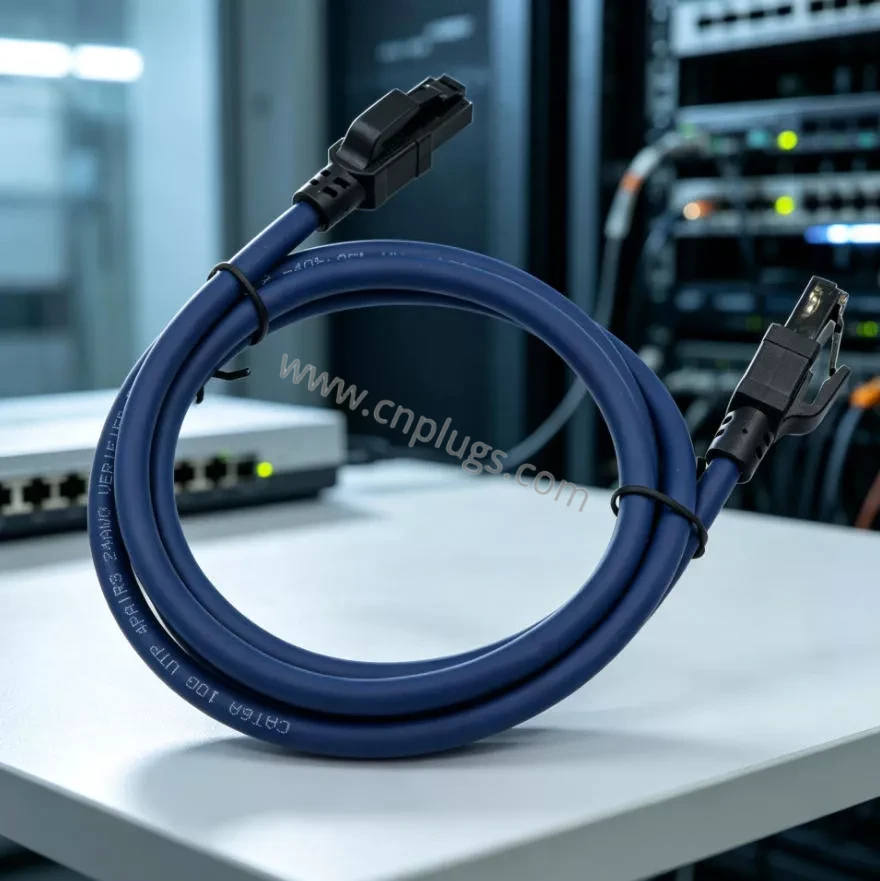
Why Standard Cables Fail in Industrial Settings
In a typical office, a standard Cat6 UTP patch cable works perfectly. But in an industrial environment, several factors combine to cause failures:
⚠️ Common Failure Modes in Industrial Environments
- Electromagnetic Interference (EMI): Motors, VFDs, and power cables generate strong EMI that corrupts data signals in unshielded cables
- Mechanical Stress: Constant vibration and movement cause conductor breakage in standard cables not designed for flexing
- Chemical Exposure: Oil, solvents, and industrial chemicals degrade PVC jackets over time
- Temperature Extremes: Standard cables may become brittle in cold or soften in heat, leading to insulation failure
- Physical Damage: Drag chains, sharp edges, and heavy equipment can crush or cut standard cable jackets
The result? Intermittent connections, data corruption, and complete network failures — all of which can shut down production lines and cost thousands in downtime.
Key Features of Industrial RJ45 Cable Assemblies
Industrial-grade RJ45 cable assemblies address these challenges with specialized construction. Here are the critical features to look for:
Shielding: The First Line of Defense Against EMI
Shielding protects your data signals from electromagnetic interference. For industrial applications, you need more than just basic shielding:
🛡️ Industrial Shielding Levels
Overall foil shield provides basic EMI protection. Suitable for light industrial environments with minimal interference.
✅ Good for: Office-adjacent industrial areas
❌ Not for: Heavy machinery, VFDs, motor drives
Braided copper shield provides 90%+ coverage with excellent flexibility. Better for movement and vibration.
✅ Good for: Drag chains, moving equipment, moderate EMI
❌ Not for: Extreme EMI environments
Combines foil and braided shields for maximum EMI protection. The gold standard for industrial environments.
✅ Good for: VFD cabinets, motor drives, welding equipment, medical imaging
✅ Recommended for: Most industrial applications
Individual pair shielding (PiMF) plus overall braided shield. Provides protection against alien crosstalk and maximum EMI resistance.
✅ Good for: PROFINET, EtherCAT, high-speed industrial networks
✅ Best for: Mission-critical industrial communications
PROUNTA Recommendation: For most industrial applications, SF/UTP (Foil + Braid) provides the best balance of protection, flexibility, and cost-effectiveness.
Jacket Materials: PVC vs. LSZH vs. PUR
The cable jacket protects against physical damage, chemicals, and environmental factors. Choosing the right material is crucial for longevity:
| Material | Pros | Cons | Best For |
|---|---|---|---|
| PVC (Polyvinyl Chloride) | ✅ Low cost ✅ Good flexibility ✅ Widely available |
❌ Poor oil resistance ❌ Emits toxic fumes when burned ❌ Limited temperature range |
Office environments, light industrial |
| LSZH (Low Smoke Zero Halogen) | ✅ Low smoke emission ✅ Halogen-free (safer) ✅ Better chemical resistance |
❌ Slightly higher cost ❌ Less flexible than PVC |
Public buildings, tunnels, confined spaces |
| PUR (Polyurethane) | ✅ Excellent oil resistance ✅ Superior abrasion resistance ✅ Exceptional flex life (millions of cycles) ✅ Wide temperature range (-40°C to +90°C) ✅ UV resistant |
❌ Highest cost ❌ Slightly stiffer than PVC |
⭐ Industrial drag chains, automation, robotics |
PROUNTA Recommendation: For industrial applications with drag chains or exposure to oils, PUR jacket is the superior choice despite the higher cost. For general industrial use, LSZH provides a good balance of safety and performance.
Connectors: Metal Shell vs. Plastic Housing
The connector is the most vulnerable part of any cable assembly. In industrial environments, connector failure is a common cause of network issues:
🔌 Connector Comparison for Industrial Use
Standard connectors with plastic housing are suitable for office environments but lack the durability needed for industrial applications.
✅ Good for: Office, commercial buildings
❌ Not for: Industrial environments, high-vibration areas
Metal shell connectors provide 360° shielding continuity, superior durability, and better protection against physical damage. The metal shell connects to the cable’s shield for complete EMI protection.
✅ Good for: Industrial environments, EMI protection
✅ Features: 360° shielding, fork ground, rugged construction
✅ Recommended for: All industrial applications
PROUNTA Recommendation: Always use metal shell connectors for industrial Ethernet cable assemblies. The slight increase in cost is justified by the dramatic improvement in reliability and lifespan.
Conductor Gauge: 23AWG vs. 24AWG for Industrial Use
Wire gauge affects both electrical performance and physical durability. For industrial applications, the choice often comes down to 23AWG vs. 24AWG:
| Feature | 23AWG | 24AWG |
|---|---|---|
| Conductor Diameter | 0.574 mm | 0.511 mm |
| Current Capacity | Higher (better for PoE++) | Standard (good for PoE) |
| Flexibility | Slightly stiffer | More flexible |
| Durability | Better for industrial | Good for office |
| Connector Compatibility | Requires large-bore connectors | Standard connectors work |
| Best For | Industrial, PoE++, long runs | Office, standard PoE, short runs |
PROUNTA Recommendation: For industrial applications, especially those involving PoE++ or long cable runs, 23AWG conductors provide better performance and durability. Just make sure to use connectors with large bore holes (1.05mm+) to accommodate the thicker conductors. Check our Wire Gauge Guide for more details.
How to Specify Your Industrial Ethernet Cable Assembly
Specifying the right industrial Ethernet cable assembly requires attention to several key parameters. Use this checklist when requesting a quote:
✅ Industrial Ethernet Cable Assembly Specification Checklist
- Category: Cat5e, Cat6, Cat6A, Cat7, or Cat8
- Shielding Type: UTP, F/UTP, S/UTP, SF/UTP, S/FTP, or SF/FTP
- Jacket Material: PVC, LSZH, or PUR
- Jacket Color: Black, gray, blue, white, or custom
- Conductor Gauge: 23AWG, 24AWG, or 26AWG
- Conductor Type: Solid or stranded
- Connector Type: Standard RJ45, metal shell, IP-rated, or field-terminable
- Gold Plating: 3µ”, 15µ”, 30µ”, or 50µ”
- Length: Standard or custom (specify exact length)
- Quantity: Per piece, per bag, or per carton
- Packaging: Bulk, retail, or custom branded
- Certifications: RoHS, REACH, CE, UL, or industry-specific
- Special Requirements: Drag chain rated, oil-resistant, UV-resistant, etc.
Pro Tip: Always request samples for testing in your specific environment before placing bulk orders. This helps identify any compatibility issues early.
Common Industrial Applications
Industrial Ethernet cable assemblies are used across various sectors. Here are the most common applications:
🏭 Manufacturing Automation
Connecting PLCs, sensors, and HMIs on production lines. Requires drag-chain rated cables with PUR jacket and SF/UTP shielding.
Recommended: Cat6A or Cat7, SF/UTP, PUR, 23AWG
⚡ Variable Frequency Drives (VFDs)
Connecting VFDs to control systems. High EMI environment requires maximum shielding and metal shell connectors.
Recommended: Cat7, SF/FTP, PUR, 23AWG, metal shell
🤖 Robotics & AGVs
Power and data for robotic arms and automated guided vehicles. Requires extreme flexibility and durability.
Recommended: Cat6A, S/FTP, PUR, 24AWG, high-flex
🏥 Medical Equipment
Connecting medical imaging devices, patient monitors, and surgical robots. Requires LSZH or PUR jacket for safety.
Recommended: Cat6A or Cat7, SF/UTP, LSZH/PUR, 24AWG
🚗 Automotive Manufacturing
Networking on assembly lines with exposure to oils, solvents, and extreme temperatures. Requires oil-resistant PUR jacket.
Recommended: Cat6 or Cat7, SF/UTP, PUR, 23AWG
📡 Outdoor & Harsh Environments
Connecting equipment in outdoor locations, underground, or in harsh weather conditions. Requires UV-resistant and water-resistant properties.
Recommended: Cat6A, SF/UTP, PUR, 23AWG, IP-rated connectors
PROUNTA Industrial Ethernet Solutions
As a leading manufacturer of RJ45 connectors and cable assemblies, PROUNTA offers a comprehensive range of industrial Ethernet solutions:
🔌 Industrial RJ45 Connectors
Metal shell connectors with 360° shielding continuity. Available for Cat5e through Cat8, with various shielding options and gold plating thicknesses.
🌐 Ethernet Patch Cables
Factory-direct Cat6 and Cat7 patch cables in various configurations. Round and flat cables, shielded and unshielded, custom lengths and colors.
→ Cat6 Round UTP Patch Cable
→ Cat7 Round Shielded Patch Cable
⚡ Specialized Industrial Plugs
VFD connectors, PROFINET plugs, field-terminable connectors, and more for specific industrial applications.
🏭 Custom Cable Assemblies
Built to your exact specifications. We can produce custom industrial Ethernet cable assemblies with any combination of category, shielding, jacket material, and connector type.
Frequently Asked Questions (FAQ)
Q: What is the difference between industrial and commercial Ethernet cables?
A: Industrial Ethernet cables are designed for harsh environments with features like enhanced shielding (SF/UTP or better), oil-resistant jackets (PUR), metal shell connectors, and wider temperature ranges. Commercial cables lack these protections and will fail quickly in industrial settings.
Q: Do I need shielded cables for my industrial application?
A: If your cables run near motors, VFDs, power cables, or any source of electromagnetic interference, then yes, shielded cables are essential. For most industrial environments, we recommend at least SF/UTP (foil + braid shielding) for reliable performance.
Q: What jacket material should I choose for my industrial Ethernet cables?
A: It depends on your environment:
- PUR: Best for drag chains, exposure to oils, and extreme flexibility requirements
- LSZH: Best for public buildings, tunnels, or anywhere fire safety is a concern
- PVC: Only for light industrial or cost-sensitive applications
Q: Can you provide custom lengths for industrial Ethernet cable assemblies?
A: Yes, we can produce any length from 0.3m to 100m or more. Custom lengths have a minimum order quantity of 500 pcs. For prototype or testing purposes, we can provide samples in standard lengths first.
Q: What is the lead time for custom industrial Ethernet cable assemblies?
A: Standard configurations (Cat6, SF/UTP, PVC, standard lengths) have a lead time of 15-20 days. Custom configurations (special shielding, PUR jacket, custom lengths) typically require 20-25 days. Rush orders may be available for urgent projects.
Q: Do your industrial Ethernet cables support PoE and PoE++?
A: Yes, our industrial Ethernet cables are designed to support PoE, PoE+, and PoE++ applications. For PoE++ (IEEE 802.3bt Type 4, up to 90W), we recommend using 23AWG conductors and Cat6A or Cat7 for optimal performance and heat dissipation.
Related Articles
UTP vs. STP RJ45 Plugs: When Should You Use Shielded Connectors?
Learn when to use shielded vs. unshielded connectors for your networking applications.
Cat5e vs. Cat6 vs. Cat6A vs. Cat8 RJ45 Plugs: A Buyer’s Guide
Compare different category RJ45 plugs and choose the right one for your network.
How to Choose the Right RJ45 Plug for 23 AWG, 24 AWG, and 26 AWG Cable
Understand wire gauge compatibility and choose the right connector for your cable.
RJ45 Gold Plating Guide: How to Specify 3µ, 15µ, and 50µ Contacts
Learn about gold plating thickness and how it affects performance and lifespan.
Need Custom Industrial Ethernet Cable Assemblies?
PROUNTA manufactures custom industrial Ethernet cable assemblies to your exact specifications. We offer Cat5e through Cat8, various shielding options, PUR/LSZH jackets, and metal shell connectors.
PROUNTA – Dongguan Prounta Electronics Co., Ltd.
Factory-direct manufacturer of RJ45 connectors, Ethernet cable assemblies, and industrial networking solutions.
WhatsApp: +86 134 2850 9915 | Email: [email protected] | WeChat: oufujun
 WeChat ID: